

With a desk job, bunion surgery recovery time is usually 2 to 4 weeks off work; if you stand or walk at work, it is 6 to 12 weeks. Most people may walk from the first day, in a post-op shoe with their weight through the heel; only after a Lapidus fusion is partial weight-bearing required for six weeks. These are ranges from clinic plans, not promises: procedure, job and healing decide, and your surgical team signs you off.
Contents
- How long are you off work after bunion surgery?
- How soon can you walk after bunion surgery?
- What should you not do after bunion surgery?
- When can you drive again after bunion surgery?
- When do shoes, cycling, swimming, sport and travel come back?
- How long does the toe stay stiff after bunion surgery, and what helps?
- Conclusion
- Frequently asked questions about bunion surgery recovery time
- Sources
How long are you off work after bunion surgery?
The length of time depends on two things: what you do with your feet at work, and what was done to your foot. The figures in this section come from German and Swiss sources. The review in the German medical journal Deutsches Ärzteblatt names about 4 weeks for sitting work and about 12 weeks for standing work, and the figures of the practices and clinics fall within exactly this range.
| Type of work | Time off work (range in German and Swiss sources) |
|---|---|
| Mainly sitting, foot can be raised, short journey to work | 2 to 4 weeks |
| Mainly standing or walking | 6 to 12 weeks |
| Heavy physical work, work safety with safety shoes | 8 to 12 weeks or longer |
The Berlin practice ORTHO PEDE expects 2 to 4 weeks for office work, 6 to 8 weeks for jobs on your feet and 8 to 12 weeks or longer for physically demanding work; in the first 1 to 3 weeks, until the stitches are out, practically nobody is fit for work. The Berlin foot surgeon Dr Tonio Gottlieb names about 2 weeks for sitting work and an individual assessment after about 8 weeks for standing jobs, the practice of Dr Fecher in Aschaffenburg about 3 to 6 weeks overall, the St. Elisabeth-Hospital Meerbusch 8 to 12 weeks for walking and standing work, and the Kantonsspital Aarau in Switzerland 2 to 12 weeks depending on the job. Twelve weeks for physical work is therefore normal and not a sign that things are going badly.
The procedure shifts the range up or down:
| Procedure | What the sources say |
|---|---|
| Chevron, scarf, Akin (open correction) | sitting 2 to 4, standing 6 to 12 weeks; 3 to 6 weeks after osteotomy according to the Gelenk-Klinik; scarf up to week 6 according to Pfleghar |
| Minimally invasive correction | sitting often after 2 to 3 weeks, physically demanding work 4 to 6 weeks; in two studies 4 weeks on average until return to work |
| Lapidus fusion (midfoot) | usually up to week 8, full use after 8 to 12 weeks |
| Cheilectomy (hallux rigidus) | sitting after a few days to 2 weeks, standing 2 to 12 weeks |
| Fusion of the big toe joint | usually up to week 8; in one study 3 weeks off work on average |
| Hammer toe alone | usually up to week 6 |
The ranges come from the Gelenk-Klinik Gundelfingen, the aftercare tables of the Orthopraxis Gräfelfing, OrthoPedes Duisburg, Meerbusch and the German Society for Foot and Ankle Surgery (GFFC). After minimally invasive correction, patients in a Chilean study returned to work after a median of 4 weeks, and in a French study also after 4 weeks on average, with a spread from one day to 51 days (Rojas-Toro et al. 2026, Green Halimi et al. 2024). After fusion of the big toe joint, time off work in an American series of 50 patients was 3 weeks on average, and the swelling lasted 11 weeks (Goucher and Coughlin 2006). If you have your bunion and a hammer toe corrected in one session, you will not find a separate figure for this in any plan; the Westküstenklinikum Heide writes that additional procedures need to be considered separately, and in practice the longer of the two ranges applies.
How soon can you walk after bunion surgery?
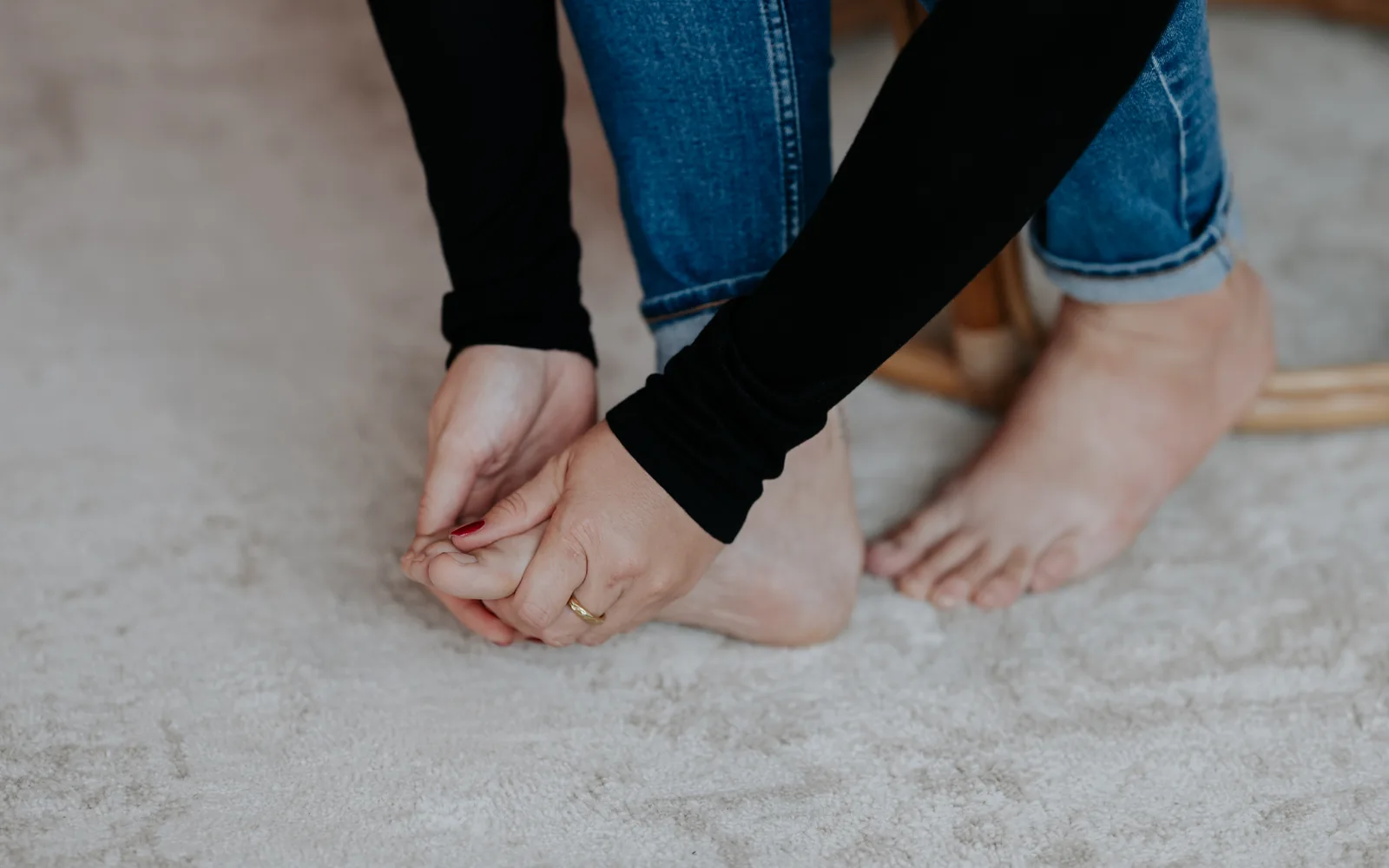
Sooner than most people think. After the common corrections, chevron, scarf, Akin and minimally invasive, you may put weight on the foot from the first day in the post-op shoe, through the heel and without rolling through; the shoe protects the cut bone, and the heel carries the load. The practice of Dr Fecher puts it like this: weight-bearing in the post-op shoe without crutches from the first day is allowed and also wanted. Only the Lapidus fusion at the midfoot is different: six weeks of partial weight-bearing with 20 kilograms in a walker boot, then a weekly increase, according to the Universitätsklinikum Münster; full weight-bearing comes after 8 to 12 weeks. More recent studies show that weight can be put through the foot earlier after a Lapidus fusion too, if the fixation is stable: 136 patients were allowed full weight-bearing after 34 days on average, and of 104 patients with early weight-bearing, 94% had bony union after six weeks (King et al. 2015, Uddin et al. 2026).
| Time after surgery | Walking and weight-bearing (chevron, scarf, minimally invasive) |
|---|---|
| Day 1 to 2 | first steps in the post-op shoe through the heel, gait training, crutches only for safety |
| Week 1 to 2 | lie down a lot and keep the foot raised, short distances in the home, no walks |
| Week 3 to 4 | only what is necessary around the house, short distances outside in the post-op shoe |
| Week 5 to 6 | X-ray, change to wide shoes, increase walking distances slowly |
| Week 8 to 12 | normal walking returns |
| Week 12 to 16 | long distances possible again too |
The rows come from the patient leaflets of the Kantonsspital Olten in Switzerland (lie down a lot for the first 14 days, 12 to 16 weeks until long distances), from Meerbusch (only the bare essentials for four weeks), from the Kantonsspital Aarau (avoid longer walking distances at first) and from the review by Wülker and Mittag (normal walking after 8 to 12 weeks).
How long do you need crutches after bunion surgery?
Often not at all. The Kantonsspital Olten and the practice of Dr Fecher do not plan for crutches, the Balgrist University Hospital in Zurich gives them to only a few patients for the first two to three days, in Aarau they are used until your gait is safe, and after minimally invasive correction most people use them for about a week. Other hospitals keep the crutches until the stitches are out after about twelve days, or for the whole four to six weeks in the post-op shoe, with full weight-bearing, as protection against tripping. After a Lapidus fusion it is two to six weeks, depending on the clinic. What they all mean: the crutch does not replace putting weight on the foot, it makes your walking safe while the stiff shoe still feels unfamiliar. Walking with your weight through the heel has to be learnt, and the best person to show you on the first day is the physiotherapist.
What happens if you have walked too much?
The most common search on this topic comes from people who have already done it. What the sources show is reassuring, and it is less than you might fear: if you put weight on the foot too early or for too long at a stretch, you get more swelling in the forefoot, and this slows down healing. None of the clinic sources describes a loss of correction or loosened screws from a walk that was too long. The rule of thumb of the ORTHO PEDE practice: if the swelling increases clearly after an activity and only improves the next day, it was too much; then take it easy for 24 to 48 hours and keep the foot raised, and after that go back to the plan. Increasing the load too early prolongs the time off work, so patience pays off twice.
Your foot needs to be seen by your surgical team if any of the following occur: suddenly stronger or a different kind of pain, redness, warmth, discharge from the wound or fever, swelling despite keeping the foot raised, new numbness, calf pain with swelling, shortness of breath or chest pain.
What should you not do after bunion surgery?
- Do not roll through the foot as long as you are wearing the post-op shoe. The forefoot stays free of load until the bone has healed, and the heel carries the weight.
- No long distances in the first weeks. Long walks are counterproductive in the first phase, according to OrthoPedes Duisburg.
- Do not let the foot hang down. In the first two to four weeks it belongs up when you sit and lie, higher than your knee.
- No water on the wound until the stitches are out, usually on day 12 to 14; baths and swimming come after that.
- Do not drive in the post-op shoe, more on this in the next section.
- Do not stop the blood-thinning injections on your own. Depending on the German clinic plan, they run for 2 to 3 days with immediate full weight-bearing, 5 to 10 days after most corrections, and until full weight-bearing after a Lapidus fusion; after forefoot procedures with immediate weight-bearing the risk is very small at 0.05%, but not zero.
- No sport too early. Starting too soon can lead to inflammation of structures that have not yet healed and prolong recovery.
When can you drive again after bunion surgery?
With the post-op shoe on your right foot, driving is not safe, and if you drive like this, you risk trouble with your insurance in an accident. Two studies have measured brake reaction time: in 42 patients operated on the right foot it was still longer after six weeks, and the authors recommended a break from driving of at least six weeks (Dammerer et al. 2016); of 60 patients, 85% passed the brake test after six weeks and all of them after eight weeks (McDonald et al. 2017). From this, the ORTHO PEDE practice derives an eight-week break from driving for the right foot and for cars with a manual gearbox; for the left foot in an automatic, in its view the time until the stitches are out after two weeks is enough. The clinics usually allow driving again with the change to an off-the-shelf shoe, that is in week 5 to 6, and later after fusions: six weeks after arthrodesis according to Dr Fecher and the Orthopraxis Gräfelfing, ten weeks after fusion of the big toe joint according to the Kantonsspital Olten. After a minimally invasive correction, patients in one study were back behind the wheel after a median of four weeks. After day surgery, one rule always applies: do not drive yourself home. In the UK, also check with your motor insurer before you drive again.
When do shoes, cycling, swimming, sport and travel come back?
| What | Range in the sources |
|---|---|
| Normal, wide shoes | 4 to 6 weeks after chevron and scarf, about 1 week after minimally invasive correction, 6 to 8 weeks after fusion of the big toe joint; one size larger at first because of the swelling |
| Tight or high-heeled shoes | at the earliest after 6 months |
| Exercise bike | from 2 to 4 weeks (Olten), from week 6 to 7 (Duisburg, Bamberg), up to week 12 (Kassel) |
| Swimming | after the stitches are out and the wound has closed, usually from week 5 to 7 |
| Jogging | at the earliest 6 to 8 weeks after chevron, 3 to 4 months after minimally invasive correction and after fusions, not before 12 weeks after Lapidus |
| Ball sports, contact sports | 3 to 6 months, 6 to 9 months after fusion of the big toe joint, avoid contact sports for a year according to Kassel |
The figures come from the plans of Olten, Bamberg, Duisburg, Hannover, the Helios clinic in Hamburg, the Balgrist and the Schön Klinik. In the Chilean study on minimally invasive correction, patients wore wide shoes after a median of 3 weeks and normal shoes after 12 weeks, and started sport without impact after 8 weeks. The Helios clinic in Hamburg gives four to six months for pain-free rolling through the foot without swelling, and up to twelve in difficult cases. Travel: with an offloading shoe you are considered fit to travel, but you should discuss flights in the first weeks with your surgical team, because an operation within the last four weeks increases the risk of blood clots when travelling; you will need to plan for the special shoe, room to keep your foot raised and the thrombosis prevention.
How long does the toe stay stiff after bunion surgery, and what helps?
Walking comes back within weeks, but the mobility of the big toe joint (first metatarsophalangeal joint) takes longer: the review states that it can remain limited for up to a year, and after open correction 7 to 38% of joints remain stiff, and the minimally invasive technique does not change this either (Ettinger et al. 2025, Frigg et al. 2019). The reason lies in the time when the foot must not roll through: the joint stands still, and the capsule and scar shorten. What helps against this is backed by evidence. Physiotherapy from the fourth week raised the function score from 60.7 to 94.5 points within six months (Schuh et al. 2009). And in a randomised study of 39 patients after a chevron correction, 21 used a motorised continuous passive motion (CPM) device from the day of surgery, in addition to physiotherapy, for eight hours a day over 24 days; their joint was more mobile at every follow-up visit, and they returned to normal shoes and stopped taking painkillers sooner (Connor et al. 1995). The study used a different device from the one described below. In the author’s experience with his own patients, normal rolling through the foot and walking without impairment also become possible sooner this way. The window for this is exactly the phase in which you are still off work and must not roll through the foot.
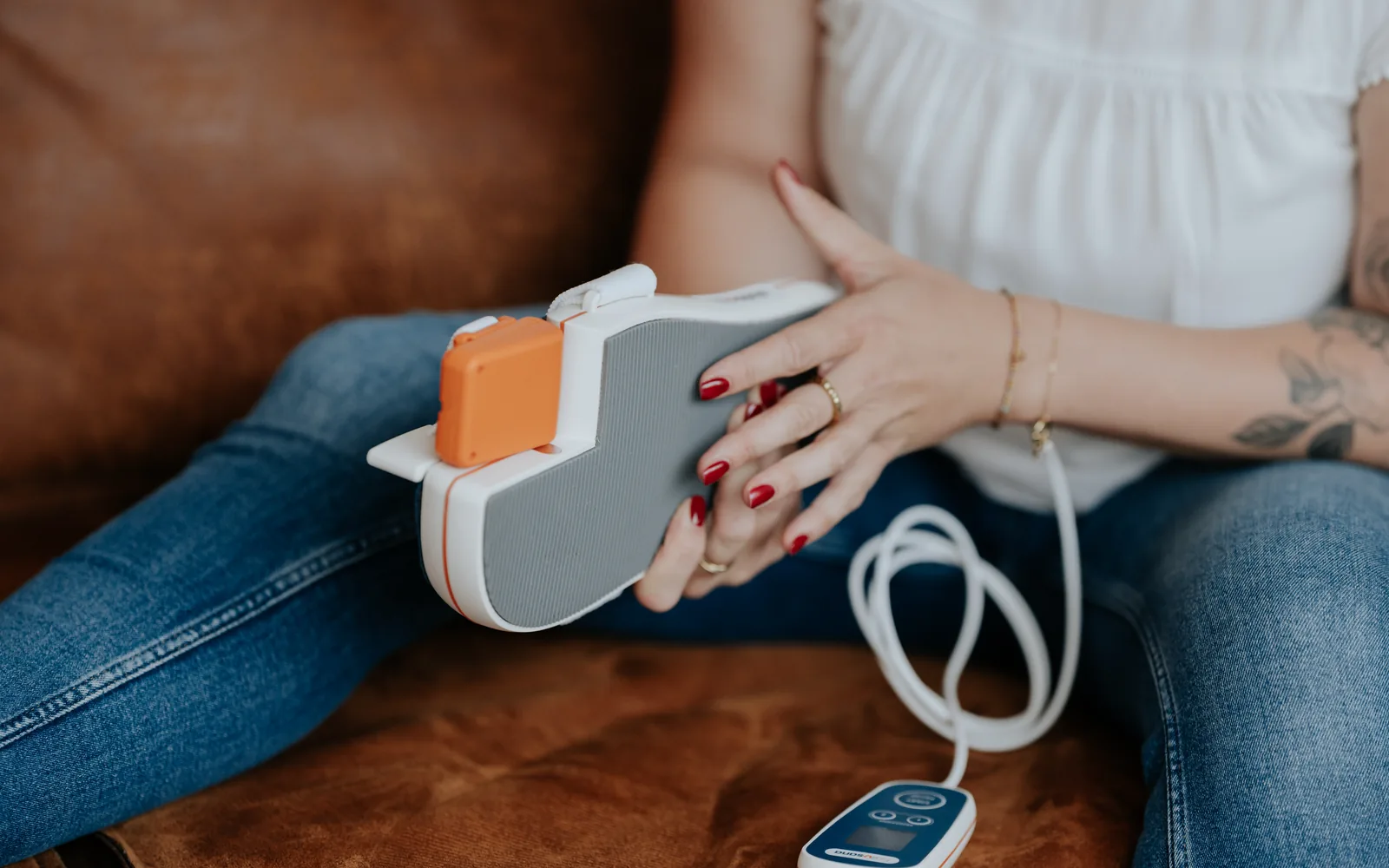
Passive motion at home after surgery
The Hall-U-Sana® toe CPM device moves the big toe joint with a motor and without any effort on your part: programme 1 for the phase directly after surgery with 20 degrees up and 10 degrees down, programme 2 for the later phase with 40 and 20 degrees, each for 25 minutes twice a day while you sit. There is nothing to set: you place your foot in the device and start the programme. Hall-U-Sana® is a Class IIa medical device (CE) for rehabilitation after surgery on the first ray. It is available to rent through distribution partners in Germany, Switzerland and France, see Sources of supply, and the studies are on the studies page. It is not cleared by the FDA and is not available in the United States. Whether and from when the motion splint makes sense after your operation is decided by your surgeon.
Conclusion
Two to four weeks at a desk, six to twelve weeks in a job on your feet, eight weeks and more after fusions: that is the usual framework, and it is similar among all the specialists. You may almost always walk straight away, through the heel and in the post-op shoe, just not far; long distances come after three to four months. If you have walked too much, you have usually only caused swelling, and you can make up for it with two quiet days. The car stays parked for six to eight weeks, tight shoes for half a year. And while the bone and wound need their weeks, the joint should not stand still: stiffness is the late consequence that is decided during this time. Which figure applies to you is in the plan of your surgical team.
Frequently asked questions about bunion surgery recovery time
How long are you off work after hallux rigidus surgery?
After a cheilectomy, in which only the bone spurs are removed, the foot can bear weight straight away; sitting work is possible after a few days to two weeks, standing work after two to twelve weeks, depending on how things go. After a fusion of the big toe joint, the offloading shoe stays on for six to eight weeks and the time off work usually lasts until week 8; in an American series, patients were off work for three weeks on average.
How long do you need blood-thinning injections after bunion surgery?
That is set out in your clinic’s plan. In the German plans it ranges from 2 to 3 days with immediate full weight-bearing, through 5 to 10 days after most corrections, to full weight-bearing after a Lapidus fusion, that is 6 to 12 weeks. After forefoot procedures with immediate weight-bearing the risk is very low at 0.05%; with immobilisation in a walker boot or cast it rises, which is why your surgical team decides according to the procedure and your risk factors.
How long will you need painkillers after bunion surgery?
The worst pain comes in the first 24 hours, when the foot block (a local anaesthetic that numbs the foot) wears off; it lasts about ten hours. In hospital, painkillers are given according to a schedule, and after discharge usually only a low dose, which is reduced step by step as soon as the foot settles. No clinic gives a fixed number of days; after two weeks most people manage with painkillers only when needed, and keeping the foot raised noticeably reduces the pain.
When can you climb stairs after bunion surgery?
From the first day, once the physiotherapist has shown you how: stairs can be managed with elbow crutches, but not with a wheeled walking frame. What matters is putting your weight through the heel in the post-op shoe and keeping one hand on the handrail. The clinic plans give no fixed number of weeks; if you feel unsure, ask to be shown the technique before you are discharged.
Bunion and hammer toe operated on together: how long off work?
No plan gives a separate figure for the combination. Correcting a hammer toe on its own usually means four weeks in the post-op shoe, a wire that is removed after four to six weeks, and time off work until about week 6. Combined with the bunion correction, the longer of the two ranges applies, so with standing work more like 8 to 12 weeks; the Westküstenklinikum Heide advises discussing additional procedures separately.
About the author: Dr Franz Freuler is a Specialist in Orthopaedic Surgery FMH. In 2005 he built the first prototype of a motorised continuous passive motion device for the big toe joint, which became the Hall-U-Sana®. He is co-founder and CTO of U-Sana Medical AG in Oberwil near Basel.
This guide provides general information and does not replace a medical examination. How long you are off work and from when you may put weight on your foot is decided by your surgical team.
Sources
- Ettinger S, Spindler FT, Marschall U, Polzer H, Stukenborg-Colsman C, Baumbach SF. Hallux valgus: prevalence and treatment options. Dtsch Arztebl Int 2025;122:308-314. PubMed 40332014
- Wülker N, Mittag F. The treatment of hallux valgus. Dtsch Arztebl Int 2012;109:857-867. PubMed 23267411
- Rojas-Toro DE, Protasowicki N, Ruiz RR et al. Return to daily and sports activities after minimally invasive transverse osteotomy and Akin (META) for hallux valgus. J Foot Ankle Surg 2026, published online ahead of print. PubMed 42235816
- Green Halimi Y, Efrima B, Elkaïm M et al. Hallux valgus treatment by percutaneous scarf-like screwless osteotomy. Orthop Traumatol Surg Res 2024;110:103963. PubMed 39059549
- Goucher NR, Coughlin MJ. Hallux metatarsophalangeal joint arthrodesis using dome-shaped reamers and dorsal plate fixation. Foot Ankle Int 2006;27:869-876. PubMed 17144945
- Dammerer D, Braito M, Biedermann R, Ban M, Giesinger J, Kaufmann G. Effect of surgical shoes on brake response time after first metatarsal osteotomy: a prospective cohort study. J Orthop Surg Res 2016;11:14. PubMed 26792613
- McDonald E, Shakked R, Daniel J, Pedowitz DI, Winters BS, Reb C, Lynch MK, Raikin SM. Driving after hallux valgus surgery. Foot Ankle Int 2017;38:982-986. PubMed 28608725
- King CM, Richey J, Patel S, Collman DR. Modified Lapidus arthrodesis with crossed screw fixation: early weightbearing in 136 patients. J Foot Ankle Surg 2015;54:69-75. PubMed 25451208
- Uddin F et al. Early weightbearing after Lapidus arthrodesis: union and outcomes in 104 patients. J Foot Ankle Surg 2026;65:24.e1-24.e8. PubMed 41022308
- Malhotra K, Houchen-Wolloff L, Mason L, Mangwani J. Characteristics of patients not receiving chemical thromboprophylaxis following foot and ankle surgery (UK-FATE). Foot Ankle Int 2024;45:943-949. PubMed 38872313
- Frigg A, Zaugg S, Maquieira G, Pellegrino A. Stiffness and range of motion after minimally invasive chevron-Akin and open scarf-Akin procedures. Foot Ankle Int 2019;40:515-525. PubMed 30688526
- Schuh R, Hofstaetter SG, Adams SB, Pichler F, Kristen KH, Trnka HJ. Rehabilitation after hallux valgus surgery: importance of physical therapy to restore weight bearing of the first ray during the stance phase. Phys Ther 2009;89:934-945. PubMed 19608631
- Connor JC, Berk DM, Hotz MW. Effects of continuous passive motion following Austin bunionectomy. A prospective review. J Am Podiatr Med Assoc 1995;85:744-748. PubMed 8592286
- ORTHO PEDE Berlin, Dr. med. Stefan Böhr: Sick leave and time off work after hallux valgus surgery, as of September 2026 (in German). ortho-pede.de
- ORTHO PEDE Berlin, Dr. med. Stefan Böhr: Pain after hallux valgus surgery, what is normal and what is not, 17 February 2026 (in German). ortho-pede.de
- ORTHO PEDE Berlin, Dr. med. Stefan Böhr: When can I drive again after hallux valgus surgery, as of 21 February 2026 (in German). ortho-pede.de
- Praxis für Orthopädie und Sportmedizin Aschaffenburg, Dr. med. Klaus Fecher: Hallux valgus, aftercare (in German). dr-fecher.de
- Fußchirurgie Berlin, Dr. med. Tonio Gottlieb: Hallux valgus surgery, procedure and aftercare (in German). der-fusschirurg.de
- OrthoPedes Duisburg, Dr.-medic Manuel Nastai: After foot surgery, what happens next? (in German). drnastai.de
- OrthoPedes Duisburg, Dr.-medic Manuel Nastai: Minimally invasive hallux valgus surgery (in German). drnastai.de
- Gelenk-Klinik Gundelfingen, Dr. med. Thomas Schneider: Hallux valgus surgery, treating bunions for the long term (in German). gelenk-klinik.de
- Orthopraxis Gräfelfing, Dr. med. Ulrich Pfleghar: Aftercare plan for fusion of the big toe joint (PDF, in German). fusschirurgie-pfleghar.de
- Westküstenklinikum Heide, Dr. Roman Mroz, PD Dr. Jakob Nüchtern: Foot surgery, patient brochure, April 2026 (PDF, in German). westkuestenklinikum.de
- St. Elisabeth-Hospital Meerbusch, Fußchirurgisches Zentrum, Dr. Robert Van Ende: Patient information on hallux valgus (PDF, in German). rrz-meerbusch.de
- Kantonsspital Aarau, Klinik für Orthopädie und Traumatologie: Patient information on hallux valgus treatment (PDF, in German). ksa.ch
- Kantonsspital Olten, Dr. med. Sandra Meier, Dr. med. Katharina Cichon: Patient information on hallux valgus (PDF, in German). solothurnerspitaeler.ch
- Kantonsspital Olten, Dr. med. Sandra Meier, Dr. med. Katharina Cichon: Patient information on hallux rigidus (PDF, in German). solothurnerspitaeler.ch
- Universitätsklinik Balgrist Zürich: Fusion of the big toe joint, patient information (PDF, in German). balgrist.ch
- Universitätsklinikum Münster, Klinik für Unfall-, Hand- und Wiederherstellungschirurgie, Prof. Dr. Sabine Ochman: Aftercare plan for hallux valgus, Lapidus (PDF, 10/2023, in German). ukm.de
- Klinikum Bamberg, Prof. Dr. med. Peter Strohm, Dr. med. A. Saal: Aftercare plan for fusion of the big toe joint, 02/2023 (PDF, in German). sozialstiftung-bamberg.de
- Helios Gesundheit, Philip Krekosch, senior physician at the Helios ENDO-Klinik Hamburg: Hallux valgus, as of 15 September 2026 (in German). helios-gesundheit.de
- Institut für Qualität und Wirtschaftlichkeit im Gesundheitswesen (IQWiG), gesundheitsinformation.de: Surgery for hallux valgus, as of 9 October 2024 (in German). gesundheitsinformation.de
- Orthopraxis Gräfelfing, Dr. med. Ulrich Pfleghar: Aftercare plan for PIP fusion, hammer and claw toes (PDF, in German). fusschirurgie-pfleghar.de
- Gesellschaft für Fuß- und Sprunggelenkchirurgie e.V. (GFFC): Patient information on hallux valgus (in German). gesellschaft-fuer-fusschirurgie.de
Sources as of 2 November 2026. The online sources were accessed on this date, and the studies are linked via PubMed.