

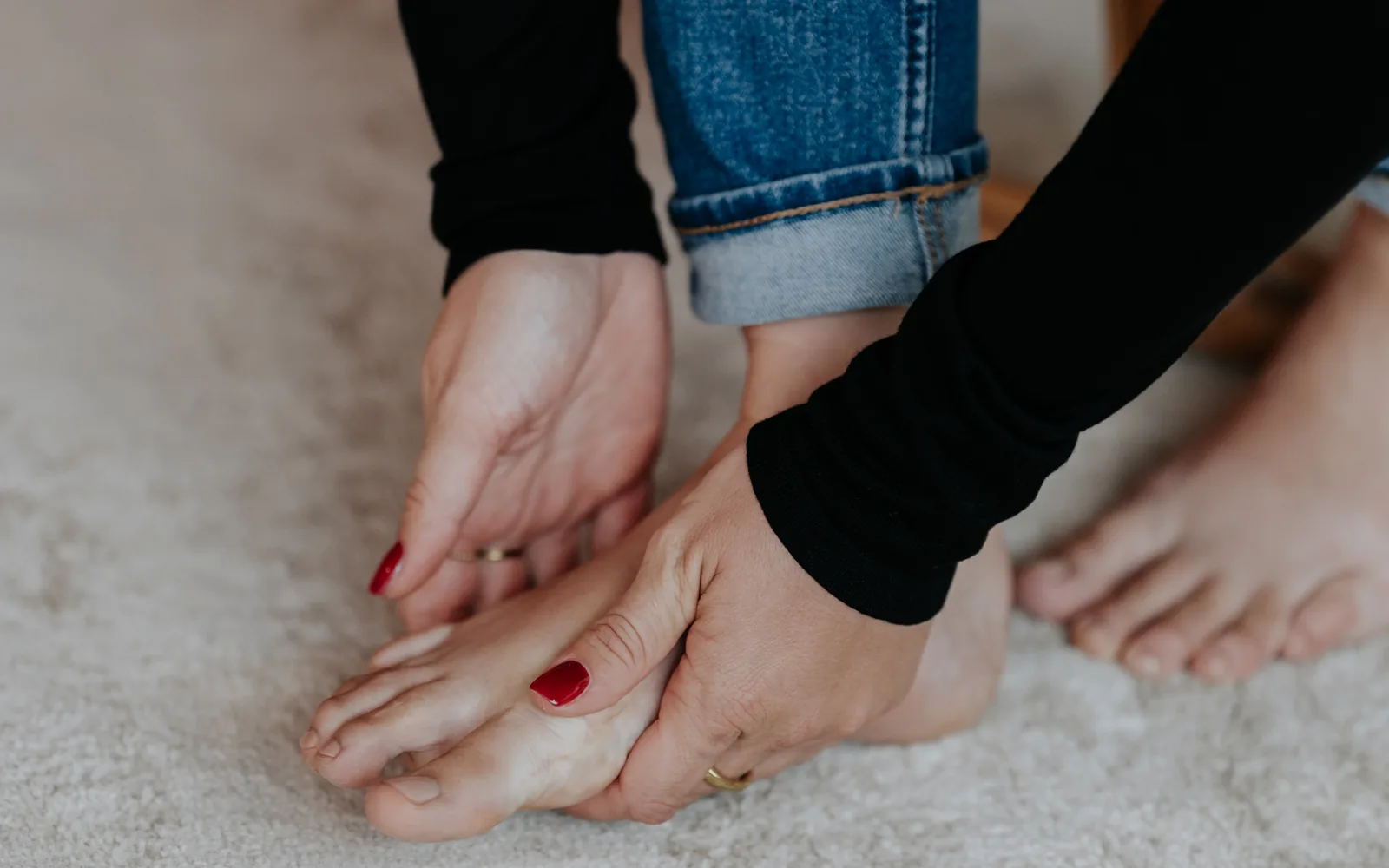
The first exercises after bunion surgery start on day one: moving the feet up and down at the ankle against thrombosis, circling the ankles, keeping the foot raised. Depending on the clinic, the big toe is moved from day 1 or only after bone healing in week 5 to 6, passively by hand, then actively; gait training and foot exercises follow from week 4 to 6. Exercises maintain what the operation achieved; your surgical practice decides what and from when.
Contents
- Why are exercises after bunion surgery important, and what can they not do?
- When can you start exercising after bunion surgery?
- Which exercises make sense in the first week?
- Which exercises are good for the big toe joint?
- Which exercises are added once the bone has healed?
- How often and for how long should you exercise?
- What should you not do when exercising?
- What is different after surgery for hallux rigidus?
- Who shows you the exercises?
- Does a CPM device help in addition to the exercises?
- Conclusion
- Frequently asked questions about exercises after bunion surgery
- Sources
Why are exercises after bunion surgery important, and what can they not do?
When a bunion is corrected, depending on the technique, the joint capsule is opened and tightened, and the metatarsal bone is cut and fixed with screws. After that, the big toe joint (first metatarsophalangeal joint) is kept still, often for weeks in the post-op shoe, and that is exactly the problem: immobilisation lets fatty connective tissue grow into the joint, adhesions form, the cartilage shrinks, and in animal experiments the strength of the ligaments falls to about a third (Akeson et al. 1987). After open correction the joint remains stiff in 7 to 38% of patients, and the minimally invasive technique does not change this (Frigg et al. 2019); in a Spanish cohort, 4.1% had a stiff joint and 6.5% chronic residual pain after twelve months (Buendía-Ayala et al. 2026). The Balgrist University Hospital in Zurich tells its patients so in its information sheet: because the capsule is tightened, stiffness can occur, and it normally recovers with physiotherapy.
What exercises achieve has been measured in Vienna. Thirty patients wore the post-op shoe for four weeks after a chevron or scarf procedure and then received a rehabilitation programme once a week for four to six weeks; by the sixth month the function score rose from 60.7 to 94.5 points, and the force under the big toe from 66.1 to 87.2 newtons (Schuh et al. 2009). In the same research group, the peak pressure under the big toe when walking rose from 80.7 kilopascals in week 4 to 171.9 in week 8 and to 336.1 after six months, so the foot learned to roll through again (Schuh et al. 2008). To be honest: neither study had a comparison group without physiotherapy. A systematic search for randomised studies on rehabilitation after bunion surgery found not a single one on exercise programmes in 2025, only on weight-bearing, splints, ultrasound and shoes (Gumuskaya et al. 2025). The guideline of the German foot surgeons lists passive and active exercise of the big toe joint, lymphatic drainage and measures against swelling as postoperative measures, without timing and without dosage, and states that they vary considerably between procedures. Exercises are therefore experience-based medicine with good reasons behind them, not a guarantee. What they cannot do: make screws grow in faster, train away swelling or correct a malalignment.
When can you start exercising after bunion surgery?
That depends on which exercise is meant. For the ankle, knee and hip the rule is the same everywhere: from the first day. For the big toe, clinics in Germany and Switzerland differ more than on any other question of aftercare:
| Clinic or practice | Big toe joint moved from |
|---|---|
| Märkische Kliniken Lüdenscheid | day 1, actively |
| Klinikum Bamberg (chevron, scarf) | day 0 to 1 passively in physiotherapy, actively from week 2 to 6 |
| Orthopraxis Gräfelfing, Dr Pfleghar | day 0, mobilisation without applying force |
| Gelenk-Klinik Gundelfingen | immediately after the operation |
| Orthopädie Zentrum Arabellapark München | toes immediately, physiotherapy from week 3 |
| Florence-Nightingale-Krankenhaus Düsseldorf | once the wound has healed, without restriction from week 6 |
| Klinikum Bamberg (minimally invasive) | week 4 on your own, physiotherapy from week 6 |
| Klinikum Kassel | week 5 to 6 within pain-free limits |
| Universitätsklinik Balgrist Zürich | once bone healing is confirmed, X-ray in week 6 |
| Marienhospital Stuttgart | no movement in the big toe joint for 8 weeks |
The range runs from day 1 to week 8, and it is not a question of right or wrong but of the procedure, the fixation and the surgeon’s conviction. Kassel goes one step further and considers exercises for the mobility of the toe joints not useful until week 12, because walking is to be trained in this phase. The Swiss hospitals in Aarau, Olten and Zurich mention no toe exercise at all in their patient leaflets; there, mobilisation is done in physiotherapy after the X-ray check. For you this means: the question “from when may I move my toe?” should be asked before you are discharged, not typed into a search engine. The exercises below are described as clinics give them, with the respective range; which of them apply to your foot is set out in your aftercare plan.
Which exercises make sense in the first week?
In the first week the focus is not on the toe but on blood flow and swelling. Almost all aftercare plans name three things:
- Calf pump. Move both feet at the same time at the ankle, pulling the tips of your feet alternately towards your nose and stretching them far forward; in addition, lying down, stretch out your legs, pull your toes towards your nose, press your knees down, tighten your thighs and buttocks, hold for two to three breaths and repeat four to five times; then bend one leg at the knee and hip, alternating sides, pull the toes towards your nose, stretch the leg and put it down, five to ten times. This is how the physiotherapy department of the Annastift in Hannover describes it. The Universitätsklinikum Münster has patients move the ankle regularly on their own from within the post-op shoe, and Oetiker in Cham recommends circling the ankle and cycling movements in bed lying on your back, several times a day. The exercise is backed by evidence: after operations on the lower limb, the calf pump lowered the risk of thrombosis to about a quarter in 16 randomised studies with 1,704 patients (Liu et al. 2025); this applies to the knee and hip, and there is no separate study for the forefoot.
- Keeping the foot raised. Above heart level, several times a day for 20 to 30 minutes in the first one to two weeks; a footstool is not enough, you need thick cushions or a wedge, according to the Munich orthopaedic surgeon Zenta. The Annastift asks for the foot to be raised consistently in the first week, if possible above heart level.
- Cooling. Three to four times a day, for a maximum of 15 minutes each time, with the cold pack wrapped in a towel and never directly on the skin; the Marienhospital Stuttgart cools two to three times a day for no more than ten minutes in the first week, Meerbusch in the first three to four weeks. After foot operations, cold relieves pain and saves painkillers, but it does not reduce swelling optimally; combined with compression it works better (Karam et al. 2025).
Hip and knee come in addition: the foot surgery centre in Meerbusch has patients move their hip, knee and ankle joints and their toes again and again with their own muscle power up to the pain threshold, because movement improves blood flow, lowers the risk of thrombosis and makes the swelling go down faster. That swelling and pain are the rule is shown by a series of measurements on 63 feet in Innsbruck; after minimally invasive correction both were lower in the first six weeks (Hofmann et al. 2026).
Which exercises are good for the big toe joint?
As soon as your aftercare plan allows the toe to be moved, there are three stages, which clinic documents describe in the same way again and again.
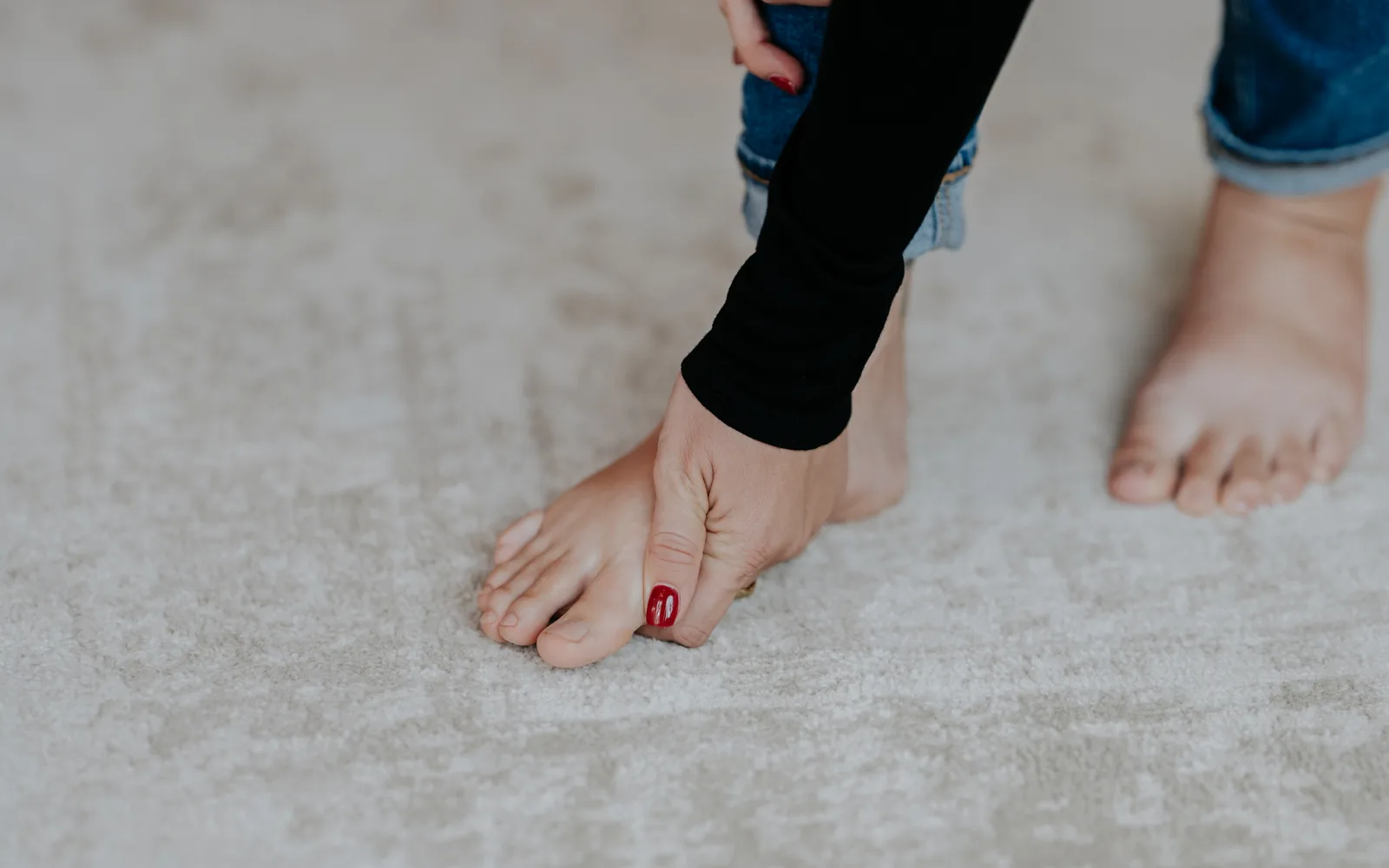
Passively with your hand. Meerbusch describes the grip: hold the metatarsal bone still with the index finger and thumb of one hand, and with the thumb and index finger of the other hand move the toe up and down under gentle lengthwise traction, up to the pain threshold. The Annastift adds pain-relieving traction: both hands close to the joint, one holding it still, the joint slightly bent, then gently pull the big toe away from the body, hold for about 40 seconds, ease off a little, pause for ten seconds; under the same traction the toe can be guided towards the top of the foot. Bamberg calls this passive physiotherapy of the big toe joint in its aftercare plan, Pfleghar mobilisation without applying force. The Munich foot surgeon Kinast points out a direction that is often forgotten: after the operation the toe tends to overextend, so it is also mobilised passively and actively downwards, towards the floor, not only upwards.
Bending and straightening actively. Lift and lower the toe with your own strength, as far as is pain-free; the Märkische Kliniken have patients do this from day 1, Bamberg from week 2 to 6, the Florence-Nightingale-Krankenhaus once the wound has healed and without restriction from week 6. No clinic gives a number of repetitions for this; the rule of thumb in specialist sources on toe exercises is one to two minutes per foot, once or twice a day, only pain-free.
Stretching and the arch. Stretch the long extensor of the big toe by holding the midfoot still and guiding the big toe towards the sole of the foot, and hold for a few seconds; activate the transverse arch by placing the heel of your hand on the top of the foot with your fingertips under the metatarsal heads, and gently spreading the forefoot into a C shape several times. The Annastift adds a warning in capital letters to the mobilisation into the corrected position: not after operations that fuse the joint, and only after consulting your doctor.
Which exercises are added once the bone has healed?
With the X-ray check in week 4 to 6 and the end of the post-op shoe, the goal changes: from protecting the bone to walking. Gait training appears in almost every aftercare plan. Bamberg starts it on day 1 or 2 in the offloading shoe to learn to walk over the neighbouring rays, Pfleghar trains walking after the X-ray in week 4 with rolling through in a normal off-the-shelf shoe, Kinast has patients instructed in walking and standing in the post-op shoe from week 3, and Kassel practises walking as normally as possible with physiotherapy from week 6 to 12. The Berlin orthopaedic surgeon Böhr names the lack of gait training as one of the three most common mistakes in aftercare, alongside overly aggressive mobilisation and increasing the load too quickly.
Then come foot exercises, which strengthen the foot and secure the result. The Gelenk-Klinik considers them essential for muscular balance and for stabilising and strengthening the foot, and recommends self-massage of the arch with a soft tennis ball. The Florence-Nightingale-Krankenhaus allows foot exercises, walking barefoot and a slow build-up of sport with an exercise bike, walking and water aerobics from week 6, and has the mobilisation exercises continued intensively from the third month if the joint is still restricted. The exercises themselves are the ones foot surgeons also recommend for hallux rigidus: gripping a towel with your toes and pulling it towards you, “playing the piano” with your toes, gently pulling individual toes away from the body, spreading your toes and holding, walking on tiptoe, on your heels, and on the inner and outer edges of the foot. In the late phase, according to Böhr, strengthening of the foot muscles, balance training and stretching of the Achilles tendon and ankle are added. What exercises can do for an irritated big toe joint is shown by the only controlled study on mobilisation of this joint, though without an operation: after twelve sessions of sesamoid mobilisation, strengthening of the big toe flexor and gait training, participants gained an average of 28 degrees of extension and lost 3.8 points of pain on a ten-point scale (Shamus et al. 2004, Zammit et al. 2010).
The scar belongs in this phase. Bamberg allows scar care one week after the stitches are removed, so from day 19 to 21; Düsseldorf covers the scar with a silicone plaster once the wound has healed and massages it with panthenol ointment from week 6. There is no study on scar massage on the foot; the benefit is a matter of experience.
How often and for how long should you exercise?
This is where the evidence gets thin, and you should know that before you follow a video. The only clinic source with holding times and repetitions is the physiotherapy department of the Annastift: hold the traction for 40 seconds with a ten-second pause, calf pump four to five times or five to ten times. For physiotherapy after bunion surgery in a practice, Kinast names two to three sessions a week from week 3, Pfleghar expects twelve treatment appointments in total, and in the Vienna study one session a week over four to six weeks from week 4 was enough. For exercising at home, the rule in specialist sources for toe exercises applies: once or twice a day for one to two minutes per foot, better short and daily than long and rarely. Lymphatic drainage, which many aftercare plans include, has only a limited lasting effect with two to three sessions a week according to Kinast, and Pfleghar points out that prescriptions for it are strictly limited. How long in total? Böhr speaks of a few weeks to months, Düsseldorf continues the mobilisation intensively from the third month for as long as mobility is restricted, and mobility improves for up to a year. The Bern foot surgeon Strehle puts it this way: physiotherapy makes sense if stiffness of the joint and persistent, marked swelling are developing.
What should you not do when exercising?
- Do not roll through over the forefoot before the X-ray allows it. Pfleghar: weight on the heel is permitted, no rolling through over the forefoot until the X-ray check in week 4; Stuttgart keeps the big toe joint completely still for eight weeks, the Balgrist until bone healing is confirmed. Standing on tiptoe and walking barefoot on hard floors therefore automatically belong to the time after the post-op shoe.
- Do not push into pain. Kassel writes that physiotherapy should never be painful, Meerbusch moves up to the pain threshold, and the practice in Beckum pauses when the joint is acutely irritated. There is an opposing view: Kinast does not consider pain during movement a reason not to do the exercise. The majority say pain-free or up to the pain threshold; if your surgeon instructs otherwise, their instructions apply.
- Do not stretch too aggressively or too early. Böhr names this as the most common mistake, together with increasing the load too quickly. According to the Gelenk-Klinik, loading too early or for too long causes swelling in the forefoot and slows healing; the Schulthess Klinik has patients keep getting up to a minimum at first to avoid secondary bleeding; Olten prescribes a lot of lying down in the first 14 days.
- Do nothing to the wound. Before the stitches are removed, no physiotherapy directly on the wound area, and the dressing stays on even during lymphatic drainage; no changing the dressing yourself, no ointments on the wound in the first six weeks without consulting your surgical team; never put the cold pack directly on the skin.
- Do not follow the wrong programme. Mobilisation into the corrected position does not apply after fusions, and the exercises from hallux rigidus videos do not apply after every bunion operation. If the surgeon and the physiotherapist disagree, the doctor’s instructions take priority.
Your foot needs to be seen by your practice if there is increasing throbbing pain, redness and swelling, a wound that looks abnormal, bleeding or increasing pain, according to the Westküstenklinikum and Düsseldorf; signs of inflammation are swelling, redness, pain and a feeling of heat. Then you do not exercise, you phone.
What is different after surgery for hallux rigidus?
After a cheilectomy, in which the bony outgrowths at the big toe joint are removed, movement is the aim of the operation, which is why it starts early and is practised intensively: Pfleghar starts mobilisation without applying force on the day of surgery, Bamberg usually begins gait training in the offloading shoe with full weight on the heel after seven days, and the Schön Klinik asks for intensive exercise after the operation. The details are in the guide to cheilectomy.
After a fusion of the big toe joint it is the other way round. The Balgrist says it clearly: once the joint has been fused, it can no longer be moved. Exercises are still done, just elsewhere: from the day of surgery to the end of the sixth week, Bamberg has the joint at the tip of the big toe (interphalangeal joint) moved passively, together with gait training in the offloading shoe, and from week 7 after the X-ray, walking, cycling and swimming. Calf pump, keeping the foot raised and lymphatic drainage apply as they do for everyone else. After a Lapidus fusion at the base of the metatarsal, the big toe joint remains free and is exercised as after an osteotomy, in Bamberg passively from day 0 to 1 and actively from week 2 to 6; the difference is the load: six weeks of partial weight-bearing with 20 kilograms, after which the load is increased by 15 to 20 kilograms a week, according to the Universitätsklinikum Münster.
Who shows you the exercises?
The first instruction comes in the hospital, usually on the first or second day together with gait training; Pfleghar advises booking physiotherapy appointments in good time. Prescribing physiotherapy is a matter for your surgical practice, and the number of sessions depends on your individual case.
Does a CPM device help in addition to the exercises?
The passive movement that clinics describe as passive physiotherapy of the big toe joint can also be carried out by a motor, using a continuous passive motion (CPM) device, over hours instead of minutes. In the only randomised study on this, 39 patients after a chevron correction were compared: 18 with physiotherapy alone, 21 additionally with a motorised motion splint for eight hours a day over 24 days; the splint group was more mobile at every follow-up visit from day 7 to day 90, returned to normal shoes sooner and stopped taking painkillers sooner (Connor et al. 1995). In ten patients whose toe had remained stiff after bunion surgery, using the splint at home for four weeks improved mobility in seven and reduced pain and stiffness in all of them (Connor and Berk 1994). Both studies used a different device from the one described below. The CPM device replaces neither the calf pump nor gait training nor foot exercises; it fills the hours in between and, in the author’s experience, effectively supports the exercises.
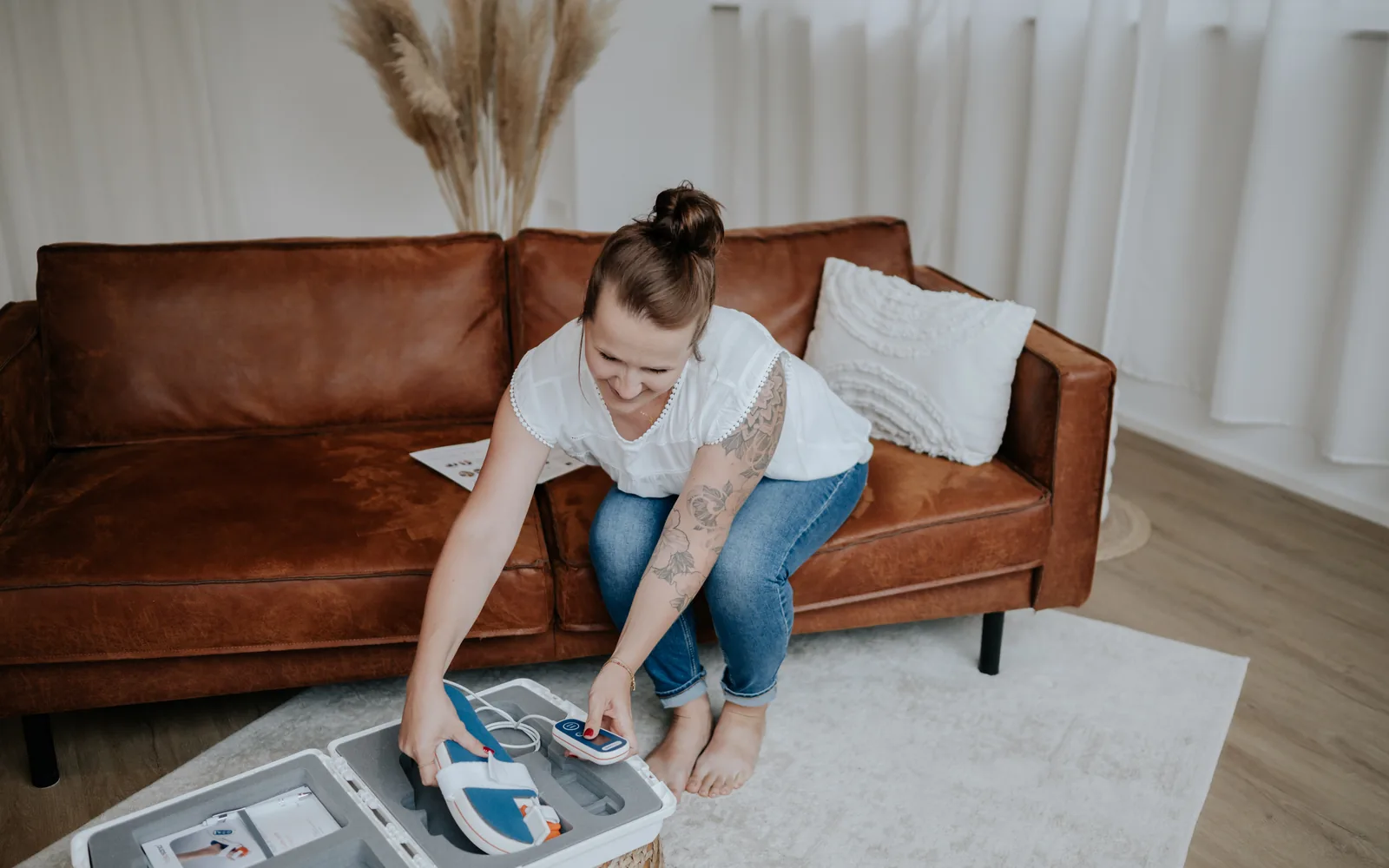
Passive motion at home after surgery
The Hall-U-Sana® toe CPM device moves the big toe joint with a motor and without any effort on your part: programme 1 for the phase directly after surgery with 20 degrees up and 10 degrees down, programme 2 for the later phase with 40 and 20 degrees, each for 25 minutes twice a day while sitting. There is nothing to set: you place your foot in the device and start the programme. Hall-U-Sana® is a Class IIa medical device (CE) for rehabilitation after surgery on the first ray. It is available to rent through distribution partners in Germany, Switzerland and France, see Sources of supply, and the studies are on the studies page. It is not cleared by the FDA and is not available in the United States. Whether and from when the device makes sense after your operation is decided by your surgeon.
Conclusion
Day 1: calf pump, keeping the foot raised, cooling; that applies everywhere. Movement of the big toe from day 1 or from week 6, depending on the clinic, first passively with your hand, then actively, never into pain. From the X-ray onwards: gait training, foot exercises, scar care, balance. Dosage only where a clinic gives one, otherwise a few minutes once or twice a day. Mobility takes months. Ask the most important question before you are discharged: from when may I move my toe, and who will show me how?
Frequently asked questions about exercises after bunion surgery
Which exercises are recommended after bunion surgery?
In the first week, the calf pump against thrombosis, keeping the foot raised and cooling. After that, as soon as your practice allows it, move the big toe passively with your hand while holding the midfoot still, then bend and straighten it actively. After the X-ray check come gait training, gripping a towel, spreading the toes, “playing the piano” with the toes, a tennis ball under the sole and balance. Which of these apply is set out in your clinic’s aftercare plan.
How long does the toe stay stiff after bunion surgery?
After open correction the big toe joint remains stiff in 7 to 38% of patients, and in one cohort 4.1% still had a stiff joint after twelve months. Mobility improves over months, measurably up to the sixth month in the Vienna study, and can keep recovering for up to a year. The earlier the joint is moved, the fewer adhesions form; how early is decided by your surgeon.
When does physiotherapy start after surgery for hallux rigidus?
After a cheilectomy, straight away: mobilisation without applying force starts on the day of surgery in Gräfelfing, gait training in the offloading shoe in the first week in Bamberg, and exercise is intensive because mobility is the goal. After a fusion of the big toe joint, the fused joint is not moved; instead the joint at the tip of the toe and the ankle are exercised, together with gait training; sport without impact from week 7.
How long does it take to walk normally after bunion surgery?
Normal walking is learned again in stages. Gait training starts in hospital in the offloading shoe and becomes the main goal after the X-ray check in week 4 to 6; Klinikum Kassel practises walking as normally as possible with physiotherapy from week 6 to 12. In the Vienna study, the pressure under the big toe when walking rose from 80.7 kilopascals in week 4 to 336.1 after six months, so rolling through the foot returns gradually over months.
Can you stretch the toe after bunion surgery if it hurts?
Most clinics say no: Kassel wants physiotherapy never to be painful, Meerbusch moves up to the pain threshold, and Beckum pauses when the joint is irritated. Some surgeons have patients exercise despite pain. Overly aggressive mobilisation and stretching too early are considered the most common mistakes. The general rule is no aggressive mobilisation if it hurts. The exact approach does depend on the clinic and the surgeon, and their instructions take priority.
About the author: Dr Franz Freuler is a Specialist in Orthopaedic Surgery FMH. In 2005 he built the first prototype of a motorised continuous passive motion device for the big toe joint, which became the Hall-U-Sana®. He is co-founder and CTO of U-Sana Medical AG in Oberwil near Basel.
This guide provides general information and does not replace a medical examination. Which exercises you may do, and from when, is decided by your surgical practice.
Sources
- Schuh R, Hofstaetter SG, Adams SB, Pichler F, Kristen KH, Trnka HJ. Rehabilitation after hallux valgus surgery: importance of physical therapy to restore weight bearing of the first ray during the stance phase. Phys Ther 2009;89:934-945. PubMed 19608631
- Schuh R, Hofstaetter SG, Kristen KH, Trnka HJ. Effect of physiotherapy on the functional improvement after hallux valgus surgery: a prospective pedobarographic study. Z Orthop Unfall 2008;146:630-635. PubMed 18846491
- Connor JC, Berk DM, Hotz MW. Effects of continuous passive motion following Austin bunionectomy. A prospective review. J Am Podiatr Med Assoc 1995;85:744-748. PubMed 8592286
- Connor JC, Berk DM. Continuous passive motion as an alternative treatment for iatrogenic hallux limitus. J Foot Ankle Surg 1994;33:177-179. PubMed 8019541
- Akeson WH, Amiel D, Abel MF, Garfin SR, Woo SL. Effects of immobilization on joints. Clin Orthop Relat Res 1987;219:28-37. PubMed 3581580
- Frigg A, Zaugg S, Maquieira G, Pellegrino A. Stiffness and range of motion after minimally invasive chevron-Akin and open scarf-Akin procedures. Foot Ankle Int 2019;40:515-525. PubMed 30688526
- Gumuskaya O, Peterson B, Donnelly H, Unver B, Lafferty D, Tehan P. Preoperative and postoperative physical and mechanical rehabilitation interventions in hallux valgus: a systematic review. J Foot Ankle Res 2025;18:e70083. PubMed 40936159
- Shamus J, Shamus E, Gugel RN, Brucker BS, Skaruppa C. The effect of sesamoid mobilization, flexor hallucis strengthening, and gait training on reducing pain and restoring function in individuals with hallux limitus: a clinical trial. J Orthop Sports Phys Ther 2004;34:368-376. PubMed 15296364
- Zammit GV, Menz HB, Munteanu SE, Landorf KB, Gilheany MF. Interventions for treating osteoarthritis of the big toe joint. Cochrane Database Syst Rev 2010;CD007809. PubMed 20824867
- Buendía-Ayala I, Buendía-Ayala J, Ridgell L et al. Risk factors for postoperative complications in hallux valgus surgery: a retrospective cohort study. J Clin Med 2026;15:5709. PubMed 42513622
- Liu X, Hu H, Jin L, Lin Q, Liu P, Li N, Chen Z. Effect of postoperative ankle pump exercises on the prevention of deep vein thrombosis and venous hemodynamics following lower limb orthopedic surgery: a meta-analysis of randomized controlled trials. J Orthop Surg Res 2025;20:863. PubMed 41024203
- Karam KM et al. Postoperative cryotherapy in joints other than the knee: a systematic review of pain, edema, analgesic use, and blood loss in the shoulder, hand, hip, and ankle joints. Orthop J Sports Med 2025;13:23259671251320132. PubMed 40160286
- Hofmann V et al. Superiority of ultra-shortterm clinical outcome after minimally invasive distal metatarsal chevron osteotomy in comparison to the open technique: a prospective study. J Foot Ankle Surg 2026;65:25.e1-25.e7. PubMed 41062058
- Deutsche Assoziation für Fuß und Sprunggelenk (D.A.F.) in der DGOU, Ettinger S, Baumbach SF (lead authors): S2e guideline hallux valgus, AWMF register number 187-051, version 5.2, section 8.2.4 postoperative measures (PDF, in German). register.awmf.org
- Klinikum Kassel, Klinik für Unfallchirurgie und Orthopädische Chirurgie, Prof. Dr. Clemens Dumont: Aftercare plan for hallux valgus surgery (PDF, 12/2022, in German). gesundheit-nordhessen.de
- Universitätsklinikum Münster, Fuß- und Sprunggelenkchirurgie, Univ.-Prof. Dr. med. Klemens Horst, Prof. Dr. med. Sabine Ochman: Aftercare plans for hallux valgus forefoot surgery and Lapidus (PDF, 10/2023, in German). ukm.de
- Klinikum Bamberg, Klinik für Orthopädie und Unfallchirurgie, Prof. Dr. med. Peter Strohm, Dr. med. A. Saal: Aftercare plans for classic and minimally invasive forefoot correction (02/2024), minimally invasive hallux valgus surgery (02/2023), fusion of the big toe joint (02/2023) and Lapidus arthrodesis (02/2023) (PDF, in German). sozialstiftung-bamberg.de
- Marienhospital Stuttgart, Klinik für Orthopädie, Unfallchirurgie und Sporttraumatologie, Prof. Dr. med. Ulrich Liener, physiotherapy Corinna Körbler: Aftercare recommendation for hallux valgus correction, 2025 (PDF, in German). marienhospital-stuttgart.de
- Orthopraxis Gräfelfing, Dr. med. Ulrich Pfleghar: Aftercare tables for scarf osteotomy and cheilectomy with chevron osteotomy, 02/2021 (PDF, in German). fusschirurgie-pfleghar.de
- St. Elisabeth-Hospital Meerbusch, Fußchirurgisches Zentrum, Dr. Robert Van Ende: Aftercare after foot surgery, patient brochure (PDF, in German). rrz-meerbusch.de
- Westküstenklinikum Heide, Fußchirurgie, Dr. med. Roman Mroz, PD Dr. med. Jakob Nüchtern: Foot surgery, patient brochure (PDF, in German). westkuestenklinikum.de
- DIAKOVERE Annastift Hannover, physiotherapy department: Physiotherapy, pages from the foot patient brochure (PDF, in German). diakovere.de
- Gelenk-Klinik Gundelfingen, Dr. med. Thomas Schneider: Hallux valgus surgery, treating bunions for the long term (in German). gelenk-klinik.de
- Orthopädie Zentrum Arabellapark München, Dr. med. Christian Kinast: Aftercare after hallux valgus surgery, 2015, updated 2016 (in German). oza-m.de
- ORTHO PEDE Berlin, Dr. med. Stefan Böhr: Physiotherapy after hallux valgus surgery, timing, goals, exercises, 2023, updated March 2026 (in German). ortho-pede.de
- MVZ im Helios München, Dr. med. Steffen Zenta: What helps best against swelling after hallux valgus surgery, 14 April 2025 (in German). mvz-im-helios.de
- Schön Klinik, Prof. Dr. Markus Walther: Hallux rigidus, treatment (in German). schoen-klinik.de
- Orthopädische Praxis Beckum, Dr. med. Jan Niklas Bröking: Exercises for the toes (in German). op-beckum.de
- Universitätsklinik Balgrist Zürich: Hallux valgus, distal metatarsal osteotomy, and fusion of the big toe joint, patient information (PDF, in German). balgrist.ch
- Kantonsspital Aarau, Klinik für Orthopädie und Traumatologie: Patient information on hallux valgus treatment (PDF, in German). ksa.ch
- Kantonsspital Olten, Dr. med. Sandra Meier, Dr. med. Katharina Cichon: Hallux valgus, patient information (PDF, in German). solothurnerspitaeler.ch
- Schulthess Klinik Zürich, foot surgery (head physician Dr. med. Philipp Friederichsen): Hallux valgus, treatment (in German). schulthess-klinik.ch
- Orthozentrum Cham, Dr. med. Rolf F. Oetiker: The time after foot surgery, information sheet (PDF, in German). orthozentrum.ch
- Hirslanden Salem-Spital Bern, Dr. med. Josef Strehle: Hallux valgus, Puls der Medizin 2011 (PDF, in German). hirslanden.ch
- Florence-Nightingale-Krankenhaus Düsseldorf, Klinik für Orthopädie: Aftercare standard after joint-preserving forefoot surgery (PDF, in German). florence-nightingale-krankenhaus.de
- Märkische Kliniken Lüdenscheid: Aftercare for hallux valgus, 05/2020 (PDF, in German). maerkische-kliniken.de
Sources as of 2 November 2026. The online sources were accessed on this date, and the studies are linked via PubMed.