

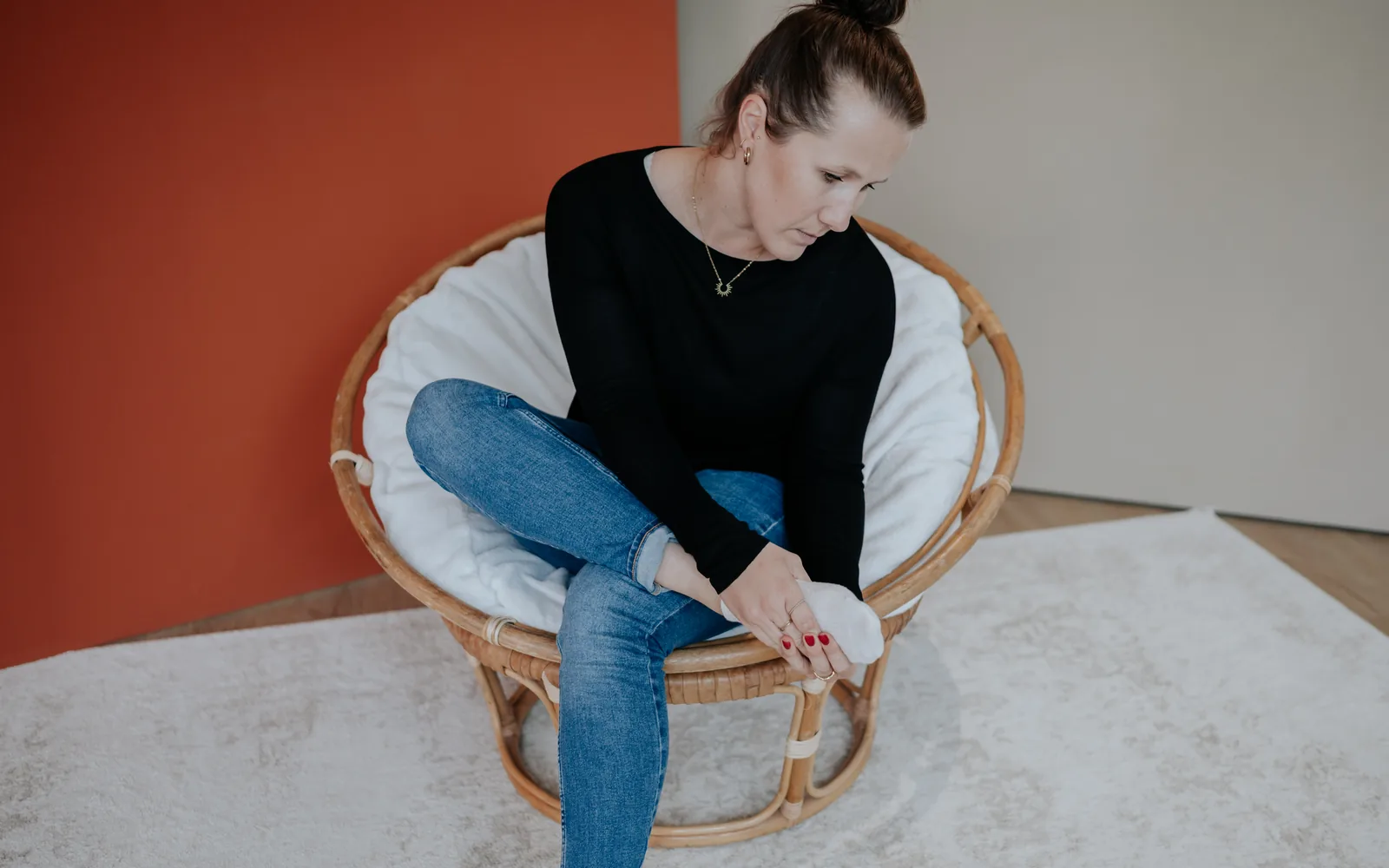
After bunion or big toe surgery, the post-op shoe is usually worn for 4 to 6 weeks: 4 to 6 weeks after chevron and scarf, 6 weeks after minimally invasive procedures and Lapidus, 2 to 4 weeks after a cheilectomy. Walk heel first, without rolling through the foot, usually with full weight-bearing. After that come wide, soft shoes with a firm sole. The shoe protects the bone, not the joint: the toe should be moved during this time.
Contents
- What is a post-op shoe and how does it work?
- How long do you have to wear the post-op shoe after bunion surgery?
- How do you walk correctly in a post-op shoe?
- What should you not do in a post-op shoe?
- Can you move your toe while you are wearing the post-op shoe?
- What comes after the post-op shoe?
- Conclusion
- Frequently asked questions about the post-op shoe
- Sources
What is a post-op shoe and how does it work?
The post-op shoe, also called a surgical shoe or forefoot offloading shoe, is an off-the-shelf shoe with a stiff sole and hook-and-loop straps that fits over the dressing and lets you walk from the first day after the operation.
There are two common designs. The forefoot offloading shoe in the narrow sense has a wedge sole that is thick under the heel and slopes down towards the front, with an offloading wedge of about 15 degrees: the weight rests on the midfoot and rearfoot, the forefoot almost floats free when you walk, and rolling through over the toes, which would load the freshly cut bone, is prevented by the design. The surgical shoe with a flat, stiffened sole lets the whole foot touch the ground but also prevents bending in the forefoot, and it has room for thick dressings. Which design you get depends on the procedure and on the clinic. A study of 80 feet after scarf osteotomy compared the two: outcome, satisfaction and the position of the bone were the same, but the wedge shoe caused back pain in 6 of 40 patients, the flat one in none (Patel et al. 2019).
How long do you have to wear the post-op shoe after bunion surgery?
How long you wear it depends on the type of operation, because it is the time the cut or fused bone needs before it can bear load without protection. The table shows the ranges from the aftercare plans of clinics in Germany and Switzerland. Which plan applies to you is set by your surgeon, and you should stick to it, even if your foot feels good earlier.
| Operation | Time in the shoe according to clinic plans | Weight-bearing in the shoe |
|---|---|---|
| Chevron (Austin) | 4 to 6 weeks | full, through the heel |
| Scarf | 4 to 6 weeks | full, through the heel |
| Minimally invasive (MICA) | 6 weeks | full, through the heel |
| Lapidus fusion | 6 weeks in a boot or walker | partial weight-bearing of 20 kilograms on crutches |
| Cheilectomy (for hallux rigidus) | 2 weeks, 4 weeks if the bone was also realigned, some clinics do without it entirely | full, through the heel |
The Universitätsklinikum Münster and the Gelenk-Klinik Gundelfingen give 6 and 4 to 6 weeks respectively for chevron, scarf and Akin, the foot surgeon in Hannover 4 weeks after chevron and 6 weeks in a walker after Lapidus, Klinikum Bamberg 6 weeks after minimally invasive correction, and the Kantonsspital Aarau in Switzerland 5 to 6 weeks, consistently, even for short distances. After a Lapidus fusion, Münster allows only 20 kilograms of partial weight-bearing for six weeks, after which the load is increased by 15 to 20 kilograms a week. After a cheilectomy the figures are shorter: if only the bone spurs are removed, two weeks are usual, and some clinics let patients put weight on the foot in a normal wide shoe as early as the day after surgery. If the bone was also realigned, the shoe stays on until the fourth week. The 2012 review in the German medical journal Deutsches Ärzteblatt sums up the usual case: after bunion correction, the foot may as a rule bear full weight in a flat surgical shoe. Which operation leads to which aftercare is described in the guide to bunion surgery.
Can you take the post-op shoe off at night?
None of the clinic plans we found requires the shoe to be worn at night. The foot surgeon in Hannover states explicitly that the walker can be taken off at night after a Lapidus fusion, and the manufacturer Bort points out in its instructions for use that the shoe is only worn at night if your doctor says so. Some clinics instead give you a toe splint for the night, which holds the big toe in the corrected position, in Lüdenscheid up to and including the sixth week. If you get up in the night, though, put the shoe on: a quick barefoot trip to the toilet is exactly the load the shoe is meant to prevent.
How do you walk correctly in a post-op shoe?
The shoe only takes the load off if you walk correctly. A pressure measurement study of 16 volunteers shows this: only a heel-focused gait reduced pressure in all areas of the forefoot, while normal rolling through in the shoe produced even more pressure under the small toes than walking barefoot (Döhner et al. 2025). How to walk correctly:
- Put your heel down first, load the foot flat, do not roll through over the toes. Your step will be shorter and a little stiffer than usual.
- In the first days, take crutches with you for safety until your walking is steady; after the stitches are out they are usually no longer needed. If you use one crutch, hold it on the side of the healthy foot.
- On the healthy foot, wear a non-slip shoe with the same heel height or a shoe raise that evens out the height difference, so that your pelvis stays level. This helps prevent back, hip and knee pain.
- Walk short distances, slowly, and take stairs using the handrail with the healthy leg first. Avoid longer distances in the first weeks.
- In the first week, do only what is necessary: walk little and keep the foot raised as much as possible, higher than your heart.
There is another reason for full weight-bearing in the shoe: it lowers the risk of blood clots. An analysis of 301,256 day-case foot and ankle procedures found blood clots (thrombosis) in 0.70% after forefoot operations, and in a British series of forefoot procedures with immediate weight-bearing and without blood-thinning medication the rate was 0.05% (Heo et al. 2026, Malhotra et al. 2024). Even so, most German clinics give a blood-thinning injection for 5 to 10 days or until full weight-bearing is safe.
What should you not do in a post-op shoe?
- Do not drive. You cannot brake safely while wearing the post-operative shoe, and in an accident there may be problems with your insurance: of 60 patients operated on the right foot, 85% passed the brake test after six weeks and all of them after eight weeks (McDonald et al. 2017); a second study recommends a break from driving of at least six weeks (Dammerer et al. 2016). If the left foot was operated on and you drive an automatic, your surgeon decides. In the UK, also check with your motor insurer before you drive again.
- Do not roll through over the forefoot, do not go up on your toes, do not walk barefoot around the house. Every step without the shoe loads the bone that is just healing.
- Do not take the shoe off for good too early, even if your foot no longer hurts. The length of time depends on bone healing, which is checked on an X-ray after four to six weeks.
- No water on the wound. From about the fifth day you can shower with the foot protected, but the dressing must not get wet; normal showering only after the stitches are out.
- Do not spend the whole day on your feet. Swelling is normal in the first weeks and goes down faster if you keep the foot up.
- Do not wear the shoe directly on the skin; if it presses or your foot goes numb, loosen it and ask your surgical team.
Can you move your toe while you are wearing the post-op shoe?
Yes, and this is the point most often misunderstood. The shoe protects the bone from the load of walking. The big toe joint, on the other hand, needs movement, otherwise it stiffens: even one week of immobilisation makes the joint capsule shrink and adhesions form (Akeson et al. 1987). The German S2e guideline on hallux valgus therefore includes passive and active movement of the big toe joint in aftercare. When this starts differs between clinics: in Lüdenscheid from the first day with active exercises, in Bamberg from the fourth week, and according to the plan of the German Institute for Quality and Efficiency in Health Care (IQWiG) as soon as the wound has healed sufficiently. Ask your surgical team from when you may gently guide the toe up and down with your hand.
Two studies show what movement during this time achieves. 39 patients after a chevron correction were divided into two groups; 21 of them used a motorised continuous passive motion (CPM) device from the day of surgery, in addition to physiotherapy, for eight hours a day over 24 days. Their joint was more mobile at every follow-up visit, and they returned to normal shoes and stopped taking painkillers sooner (Connor et al. 1995). The study used a different device from the one described below. In 30 patients who received physiotherapy from the fourth week, the function score rose from 60.7 to 94.5 points after six months, and the big toe carried load again when walking (Schuh et al. 2009).
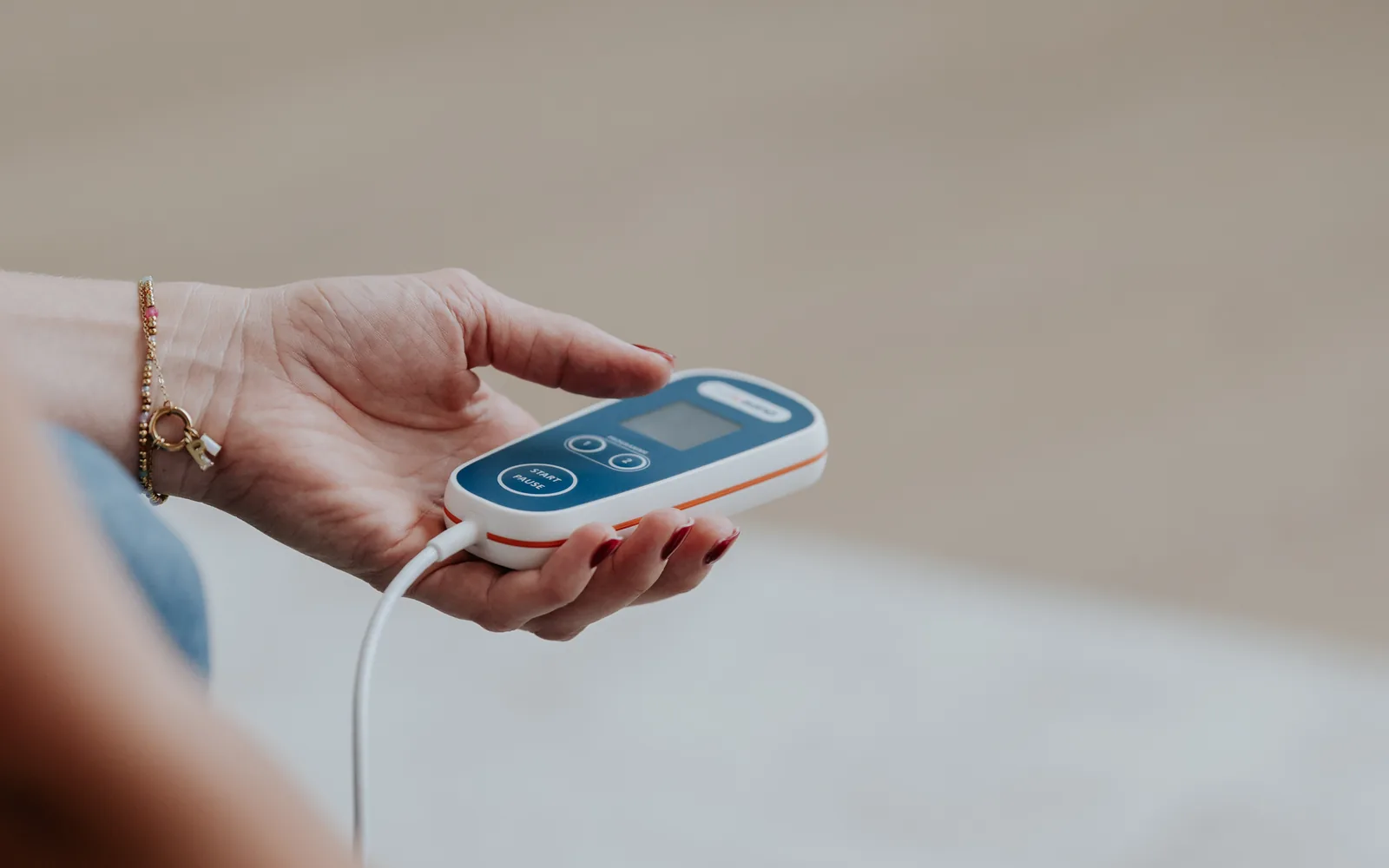
Passive motion at home after surgery
The Hall-U-Sana® toe CPM device moves the big toe joint with a motor and without any effort on your part, while your foot rests in a raised position: programme 1 for the phase directly after surgery with 20 degrees up and 10 degrees down, programme 2 for the later phase with 40 and 20 degrees, each for 25 minutes twice a day. There is nothing to set: you place your foot in the device and start the programme. Hall-U-Sana® is a Class IIa medical device (CE) for rehabilitation after surgery on the first ray. It is available to rent through distribution partners in Germany, Switzerland and France, see Sources of supply, and the studies are on the studies page. It is not cleared by the FDA and is not available in the United States. Whether and from when the device makes sense after your operation is decided by your surgeon.
What comes after the post-op shoe?
The change to a normal shoe comes after the X-ray check, usually in week 5 to 7. After that, things usually go like this:
| Time after surgery | What is usual |
|---|---|
| Week 5 to 7 | X-ray check, change to a wide, soft shoe with a stable sole, because the foot is still swollen; driving in a normal shoe usually possible again once your surgeon agrees |
| Week 6 to 12 | normal walking returns; physiotherapy and gait training; insoles are refitted; swimming, cycling, brisk walking |
| From week 6 to 8 | light running after chevron, not before week 12 after Lapidus |
| Month 3 to 6 | swelling goes down; tight shoes and high heels at the earliest after 6 months |
| First year | the foot swells more easily than before, movement of the big toe joint may remain limited for up to a year |
The figures come from the plans of Klinikum Kassel, the Kantonsspital Aarau, the Gelenk-Klinik, the foot surgeon in Hannover, the Schön Klinik and IQWiG. When choosing shoes after the post-operative shoe: wide and soft at the front so that nothing presses on the scar, with a firm sole rounded at the front so that rolling through is easy; many walking and sports shoes meet these requirements. The Gelenk-Klinik expects a further four to six weeks in soft, wide shoes after the post-operative shoe, and the Schön Klinik advises against very tight shoes for at least six months.
On time off work, German and Swiss sources give these figures: the 2025 review in the Deutsches Ärzteblatt names about 4 weeks for sitting and about 12 weeks for standing work, the Gelenk-Klinik 3 to 6 weeks after an osteotomy, and the Kantonsspital Aarau 2 to 12 weeks depending on the job. If you can work from home with your foot up, you are often back early. The journey to work counts too, because driving is only possible again without the post-operative shoe.
Conclusion
Four to six weeks, through the heel, with full weight-bearing, day after day, even for the two steps to the kitchen: that is the rule for the post-op shoe after bunion surgery, and the exception is the Lapidus fusion with partial weight-bearing. The shoe protects the bone, not the joint. If you move the toe during this time, with your hand, in physiotherapy or with a CPM device, you keep the mobility that joint-preserving operations are about. After that come wide shoes, patience with the swelling and, once your surgeon gives the go-ahead, driving and sport.
Frequently asked questions about the post-op shoe
Can you walk in a post-op shoe?
Yes, that is what it is made for. After chevron, scarf and minimally invasive corrections, the foot may as a rule bear full weight in the shoe straight away, after a Lapidus fusion only 20 kilograms on crutches for six weeks. You walk with your weight through the heel, without rolling through, with short steps. Long distances are not intended for the first weeks; walks come after the X-ray check.
Do you need crutches with a post-op shoe?
Only at the start. Crutches give you confidence in the first days until walking through the heel feels steady; foot surgeons usually let you stop using them after the stitches are out, and the Kantonsspital Aarau considers them necessary only until your gait is safe. After a Lapidus fusion they are needed for six weeks, because only 20 kilograms may be put through the foot. A single crutch is held on the side of the healthy foot.
Can you drive in a post-op shoe?
No. One manufacturer, Bort, prohibits driving with the shoe on in its instructions for use, an accident can cause problems with your insurance, and braking is measurably slower: after six weeks, 85% of those operated on the right foot passed the brake test, after eight weeks all of them. After left-foot surgery in an automatic car, some practices give the go-ahead earlier. In the UK, also check with your motor insurer. You will need someone to drive you home after the operation anyway.
Is there an alternative to the forefoot offloading shoe?
The alternative is the surgical shoe with a flat, stiffened sole. It prevents rolling through just as well, lets the whole foot touch the ground and causes back pain less often than the wedge shoe; in a study of 80 feet, outcome and satisfaction were the same. After fusions a walker or boot is used. Going completely without protection is only possible in exceptional cases, for example after a cheilectomy.
How long after bunion surgery can I wear normal shoes?
Usually after the X-ray check in week 5 to 7, once the bone has healed far enough. At first you change into a wide, soft shoe with a stable sole, because the foot is still swollen; the Gelenk-Klinik expects a further four to six weeks in such shoes. Tight shoes and high heels are possible at the earliest after six months, and the Schön Klinik advises against very tight shoes for at least that long.
About the author: Dr Franz Freuler is a Specialist in Orthopaedic Surgery FMH. In 2005 he built the first prototype of a motorised continuous passive motion device for the big toe joint, which became the Hall-U-Sana®. He is co-founder and CTO of U-Sana Medical AG in Oberwil near Basel.
This guide provides general information and does not replace a medical examination. The aftercare plan of your surgical team is what counts.
Sources
- Wülker N, Mittag F. The treatment of hallux valgus. Dtsch Arztebl Int 2012;109:857-867. PubMed 23267411
- Döhner C, Soost C, Steinhöfer S, Graw JA, Bliemel C et al. Pressure-relief effect of post-op shoes depends on correct usage while walking. Bioengineering 2025;12:489. PubMed 40428108
- Patel S, Garg P, Fazal MA, Shahid MS, Park DH, Ray P. A comparison of two designs of postoperative shoe on function, satisfaction, and radiological outcome after scarf osteotomy. Foot Ankle Spec 2019;12:228-232. PubMed 29909640
- Heo KY, Karzon A, Manz W, Kadakia RJ, Bariteau JT et al. Venous thromboembolism in outpatient elective foot and ankle procedure patients. Foot Ankle Spec 2026;19:341-354. PubMed 39396162
- Malhotra K, Houchen-Wolloff L, Mason L, Mangwani J. Characteristics of patients not receiving chemical thromboprophylaxis following foot and ankle surgery (UK-FATE). Foot Ankle Int 2024;45:943-949. PubMed 38872313
- McDonald E, Shakked R, Daniel J, Pedowitz DI, Winters BS, Reb C, Lynch MK, Raikin SM. Driving after hallux valgus surgery. Foot Ankle Int 2017;38:982-986. PubMed 28608725
- Dammerer D, Braito M, Biedermann R, Ban M, Giesinger J, Kaufmann G. Effect of surgical shoes on brake response time after first metatarsal osteotomy: a prospective cohort study. J Orthop Surg Res 2016;11:14. PubMed 26792613
- Universitätsklinikum Münster, Klinik für Unfall-, Hand- und Wiederherstellungschirurgie, Prof. Dr. Sabine Ochman: Aftercare plans for hallux valgus forefoot surgery and Lapidus (PDF, 10/2023, in German). ukm.de
- Orthopraxis Gräfelfing, Dr. med. Ulrich Pfleghar: Aftercare plans (PDF, in German) for scarf osteotomy, Lapidus arthrodesis and cheilectomy with chevron osteotomy.
- Klinikum Bamberg, Prof. Dr. Peter Strohm, Dr. A. Saal: Aftercare plan for minimally invasive hallux valgus surgery (PDF, 02/2023, in German). sozialstiftung-bamberg.de
- Klinikum Kassel, Klinik für Unfallchirurgie, Prof. Dr. Clemens Dumont: Aftercare plan for hallux valgus surgery (PDF, 12/2022, in German). gesundheit-nordhessen.de
- Gelenk-Klinik Gundelfingen, Dr. med. Thomas Schneider: Hallux valgus surgery and joint-preserving surgery for hallux rigidus (cheilectomy) (in German). gelenk-klinik.de
- Fußchirurg Hannover, Dr. med. Ryszard van Rhee: General information on the operation and frequently asked questions (in German). fusschirurg-hannover.de
- Kantonsspital Aarau, Klinik für Orthopädie und Traumatologie: Patient information on hallux valgus treatment (PDF, in German). ksa.ch
- Kassenärztliche Vereinigung Bayerns: Verordnung aktuell, prescribing shoes (surgical shoe, German aids directory 31.03.03), 14 November 2018 (PDF, in German). kvb.de
- Darco (Europe) GmbH: OrthoWedge Pro forefoot offloading shoe and MedSurg Pro surgical shoe, product information (in German). darco.de
- BORT GmbH: Instructions for use, forefoot offloading shoe (PDF, in German). bort.com
- OPED GmbH: Instructions for use, EVENup shoe raise (PDF, in German). oped.de
- Märkische Kliniken Lüdenscheid: Aftercare for hallux valgus (PDF, in German). maerkische-kliniken.de
- Akeson WH, Amiel D, Abel MF, Garfin SR, Woo SL. Effects of immobilization on joints. Clin Orthop Relat Res 1987;219:28-37. PubMed 3581580
- Connor JC, Berk DM, Hotz MW. Effects of continuous passive motion following Austin bunionectomy. A prospective review. J Am Podiatr Med Assoc 1995;85:744-748. PubMed 8592286
- Schuh R, Hofstaetter SG, Adams SB, Pichler F, Kristen KH, Trnka HJ. Rehabilitation after hallux valgus surgery: importance of physical therapy to restore weight bearing of the first ray during the stance phase. Phys Ther 2009;89:934-945. PubMed 19608631
- Deutsche Assoziation für Fuß und Sprunggelenk (D.A.F.) in der DGOU, Ettinger S, Baumbach SF et al. S2e guideline hallux valgus, AWMF register number 187-051, version 5.2, as of 23 May 2024 (in German). register.awmf.org
- Schön Klinik, Prof. Dr. Markus Walther: Hallux valgus, treatment (in German). schoen-klinik.de
- Ettinger S, Spindler FT, Marschall U, Polzer H, Stukenborg-Colsman C, Baumbach SF. Hallux valgus: prevalence and treatment options. Dtsch Arztebl Int 2025;122:308-314. PubMed 40332014
- Institut für Qualität und Wirtschaftlichkeit im Gesundheitswesen (IQWiG): Surgery for hallux valgus, patient information (in German). gesundheitsinformation.de
- Die Unfallpraxis Berlin, Dr. med. Malte Kettler: Cheilectomy (in German). die-unfallpraxis.de
- St. Elisabeth-Hospital Meerbusch, Dr. Robert Van Ende: Patient information on hallux rigidus (PDF, in German). rrz-meerbusch.de
Sources as of 9 October 2026, sources 26 to 28 as of 6 November 2026. The online sources were accessed on these dates, and the studies are linked via PubMed.