
Bunion surgery recovery week by week: the wound heals within two weeks, the cut bone is stable after six to eight weeks, the swelling takes three to six months, and the mobility of the big toe joint (first metatarsophalangeal joint) partly keeps improving for up to a year. That is why a foot still tends to swell after eight weeks, although the bone has healed firmly. Redness, discharge, fever and new pain are not normal and need attention.
Contents
- Bunion surgery recovery week by week: what heals, and in what order?
- Week 1: what is normal straight after bunion surgery?
- Week 2: when are the stitches removed?
- Weeks 3 to 4: how long does the dressing stay on?
- Weeks 5 to 6: what does the X-ray show?
- Weeks 7 to 12: when can you walk normally again?
- Months 3 to 6: how long does swelling last after bunion surgery?
- Months 6 to 12: do the screws have to come out, and why does it still hurt?
- When can you move the big toe joint again?
- Which signs need to be checked straight away?
- Is recovery different after hallux rigidus surgery?
- Conclusion
- Frequently asked questions about recovery after bunion surgery
- Sources
Bunion surgery recovery week by week: what heals, and in what order?
In a bunion correction, the first metatarsal bone is cut and realigned, the joint capsule is opened and tightened, and the skin is stitched. After that, four healing processes run side by side, each at its own pace:
| What heals | How long | How you notice it |
|---|---|---|
| Skin and wound | about 2 weeks, the scar matures for up to 12 months | stitches out, showering without protection, after a few weeks to months the scar turns from red to pale |
| Bone | stable after 6 to 8 weeks, remodelling over months | X-ray in week 5 to 6, after that the forefoot may bear increasing load |
| Capsule, ligaments, soft tissue | 3 to 6 months | swelling in the evening, a feeling of pressure, shoes one size larger |
| Joint mobility | improves for up to 12 months | rolling through the foot becomes smoother, the toe lifts and lowers further |
The bone heals in stages: first a bruise (haematoma) fills the gap, the inflammatory phase begins in the first days, in the following weeks soft callus forms and hardens by the sixth week, and remodelling into load-bearing bone continues over months (Einhorn 1998). After a chevron osteotomy, one study found the bone healed clinically and on X-ray in all patients after six weeks (Singh et al. 2004). After minimally invasive corrections, visible healing takes longer: in a series of 217 cases, the X-ray showed only 17% of osteotomies healed after six weeks, 70% after three months and 90% after six months, without the feet being any less able to bear load as a result (Schnepp et al. 2025). The Kantonsspital Olten in Switzerland sums it up for patients like this: the bone should be stable after six to eight weeks, while the capsule, tendons and ligaments stay swollen and sensitive for three to six months beyond that.
Week 1: what is normal straight after bunion surgery?
The first hours are often pain-free, because the nerve block in the foot from the anaesthetic can last for up to ten hours; then comes the phase of the strongest pain, usually during the first night. The anaesthetists’ professional society classes bunion surgery as a procedure with moderate to severe pain and recommends paracetamol combined with an anti-inflammatory painkiller, started before or during the operation and continued afterwards, with opioids only as a reserve (Wust et al. 2026). The Universitätsklinik Balgrist in Zurich speaks of a moderate episode of pain lasting a few days, the Oetiker practice in Switzerland of pain in the first one to two weeks that eases quickly.
Keep the foot up, higher than your heart or at least higher than your knee, and cool it three to four times a day, never with ice directly on the skin. You may walk from the first day in the post-op shoe with your weight through the heel, at the Balgrist without crutches, in Bamberg with gait training on the first or second day; even so, the first fourteen days mean a lot of lying down. The first dressing change comes between 48 hours and the seventh day, showering is possible from the second day with waterproof protection, and the wound itself stays dry. Depending on the plan, blood-thinning injections are given for five to seven days, until you can safely put full weight on the foot; after a Lapidus fusion with offloading, for at least six weeks. You go home the same day or after one to three nights.
Week 2: when are the stitches removed?
The stitches come out between day 10 and day 21, in most plans on day 12 to 14, at the Balgrist after three weeks, often at your GP’s surgery. Once the stitches are out, wound healing is complete, and you can shower without a cover and pat the area dry straight away; baths and saunas have to wait until healing is complete. Scar care starts now: apply cream once or twice a day, massage gently from the second week, and protect the fresh scar from the sun. It stays reddish for a few weeks to months and then gradually turns pale, as with any surgical scar. If you have a desk job, you often go back to work around this time; at the foot surgery practice in Berlin, physiotherapy starts after fourteen days at the earliest.
Weeks 3 to 4: how long does the dressing stay on?
The dressing so many people search for is usually a corrective dressing: strips of adhesive tape or a modified Kramer dressing hold the big toe in the corrected, inward position while the capsule scars. Klinikum Bamberg applies it on the day of surgery and renews it at follow-up appointments until week 6, the Märkische Kliniken bandage with an inward pull from day 1 to week 6 and add a night splint, the Universitätsklinikum Münster combines six weeks of corrective bandaging with a toe splint, and Klinikum Kassel switches to a positioning splint in week 3 to 4; all four are German hospitals. The range is therefore three to six weeks, mostly six. Keeping the foot raised and cooling it remain a must until week 4, and so does the post-op shoe; after a chevron, some practices end it as early as week 4. In some plans, exercises for the big toe joint begin now, more on this below. In week 4, the big toe still carries almost no load when you walk.
Weeks 5 to 6: what does the X-ray show?
In week 5 to 6 comes the X-ray check, in Kassel and at the Balgrist taken while standing on the foot, in Münster in three planes. It shows whether the bone has healed and is holding its position; after a chevron this is the rule at six weeks, after a minimally invasive correction the callus often only becomes visible later, but the foot can still bear load. With this result, the post-op shoe, dressing and splint come off, and the foot moves into wide, soft shoes with a stable sole, after a minimally invasive correction sometimes earlier, after fusions later. The car stays parked until this point: after six weeks, 85% of those operated on the right foot passed the brake test, after eight weeks all of them (McDonald et al. 2017). In the UK, also check with your motor insurer before you drive again. And if you were not allowed to exercise until now, you start now: at the Balgrist the big toe is mobilised once bone healing has been confirmed, in Kassel from week 5 to 6 within a pain-free range.
Weeks 7 to 12: when can you walk normally again?
How long it takes until you walk normally varies a great deal from person to person, and the type of operation also plays a large part. The review by Wülker and Mittag gives 8 to 12 weeks until walking is normal again; the Kantonsspital Olten expects 12 to 16 weeks until long distances are possible too. The reason lies in the measurements: in week 8, the big toe carries only about half of what it carries after six months; the foot only gradually readjusts to rolling through over the first ray (Schuh et al. 2008). That is why pain on loading in week 8 is not a setback but readjustment. After a Lapidus fusion, increasing the load only begins from week 7, and full weight-bearing comes after 8 to 12 weeks. Physiotherapy and, where needed, insoles belong to this phase; with exercises from week 4, the function score rose from 60.7 to 94.5 points by month 6 (Schuh et al. 2009). Sport comes back in stages: walking, cycling and swimming from week 7, jogging at the earliest after 6 to 8 weeks following a chevron, full clearance in week 12 to 13, contact sport in Kassel only after a year. In Kassel, the final check with an X-ray follows in week 12.
Months 3 to 6: how long does swelling last after bunion surgery?
Swelling is the clock that runs the longest. The Kantonsspital Aarau in Switzerland names a tendency to swell for up to half a year, swollen in the evening and gone in the morning; the Balgrist four to six months, Olten three to six months for the capsule, tendons and ligaments, the Oetiker practice up to six months and longer; in the first year, the foot swells more easily than before. What helps is unspectacular: keeping the foot up, cooling, movement, lymphatic drainage, and an elastic bandage in the first weeks; none of the plans mentions compression stockings. Nerves that were irritated during the operation recover during this time, and numbness or altered sensation in the toe usually resolves after two to three months. Tight and high-heeled shoes stay in the cupboard for at least six months, according to the Schön Klinik, and ball sports begin after three to six months. If the foot is still clearly swollen and feels stiff after three months, physiotherapy is routine.
Months 6 to 12: do the screws have to come out, and why does it still hurt?
As a rule, the screws stay in. The Kantonsspital Olten writes that they do not normally need to be removed, at the Balgrist they are left in place and only removed as a day case from the third month if they cause problems, in Bamberg on request after six months; the German foot surgery society gives about a year for Lapidus plates. In the literature the removal rate is about 10%, in reviews between 3.8 and 15.5% (Plaass et al. 2025, Spencer et al. 2026).
Pain after a year is not normal, but it is not rare either, and it has causes that can be named, for example what are known as metallosis-related complaints, meaning complaints caused by the implanted metal. Across all procedures, the review in the Deutsches Ärzteblatt gives 18.5% complications, including pain under the neighbouring toes (transfer metatarsalgia), a return of the deformity, stiffness of the big toe joint and hardware that presses. An analysis of 25 studies after scarf correction found 5.1% recurrences, 1.8% failure of the bone to heal and 5.3% complex regional pain syndrome, a nerve reaction that affects the whole foot (Sieloff et al. 2023); in a British series of elective foot operations, this rate was 4.4% (Rewhorn et al. 2014). Recurrence depends heavily on the starting point: after combined minimally invasive osteotomies, 0% for mild, 30% for moderate and 42.5% for severe deformity after twelve months (Genuth et al. 2026). If you still have pain after a year, you therefore need the final check; the foot surgery practice in Berlin plans it twelve months after the operation, with an X-ray.
When can you move the big toe joint again?
This is where clinics differ most, and you should know this before you compare recoveries: the Märkische Kliniken let patients actively move the big toe from day 1, Klinikum Bamberg starts passive physiotherapy on the day of surgery after fusions and Lapidus, and in Meerbusch the big toe joints are moved passively up to the pain threshold after the operation, with the metatarsal bone held in place and light traction. Others wait: the foot surgery practice in Berlin at least two weeks, Bamberg from week 4 after chevron and scarf, the Balgrist until bone healing is confirmed after six weeks, and Klinikum Kassel only starts independent mobilisation in week 5 to 6 and does not consider exercises for the mobility of the toe joints useful until week 12. The range therefore runs from day 1 to week 6, and it depends on the procedure and on the surgeon’s convictions.
What the data say: after a correction, the big toe joint stays permanently stiff in 7 to 38% of patients, regardless of whether open or minimally invasive surgery was performed (Frigg et al. 2019), and in the remaining cases mobility can stay limited for up to a year. Immobilisation makes the capsule and ligaments lose collagen; in animal studies, the strength of the ligaments fell to about a third (Akeson et al. 1987). Passive mobility after a chevron correction is about 59 degrees of upward bending, while the toe needs around 40 degrees when you walk, so the reserve is there as long as the joint does not stick (Nawoczenski et al. 1999). In the only randomised study of passive motion at this joint, 39 patients after a chevron (Austin) correction were compared; the 21 who used a motorised continuous passive motion (CPM) device eight hours a day over 24 days from the day of surgery, in addition to physiotherapy, were more mobile at every follow-up visit from day 7 to day 90, returned to normal shoes sooner and stopped taking painkillers sooner (Connor et al. 1995). The study used a different device from the one described below. Whether and from when your joint is moved is decided by your surgical team; ask about it before you set your expectations for your recovery.
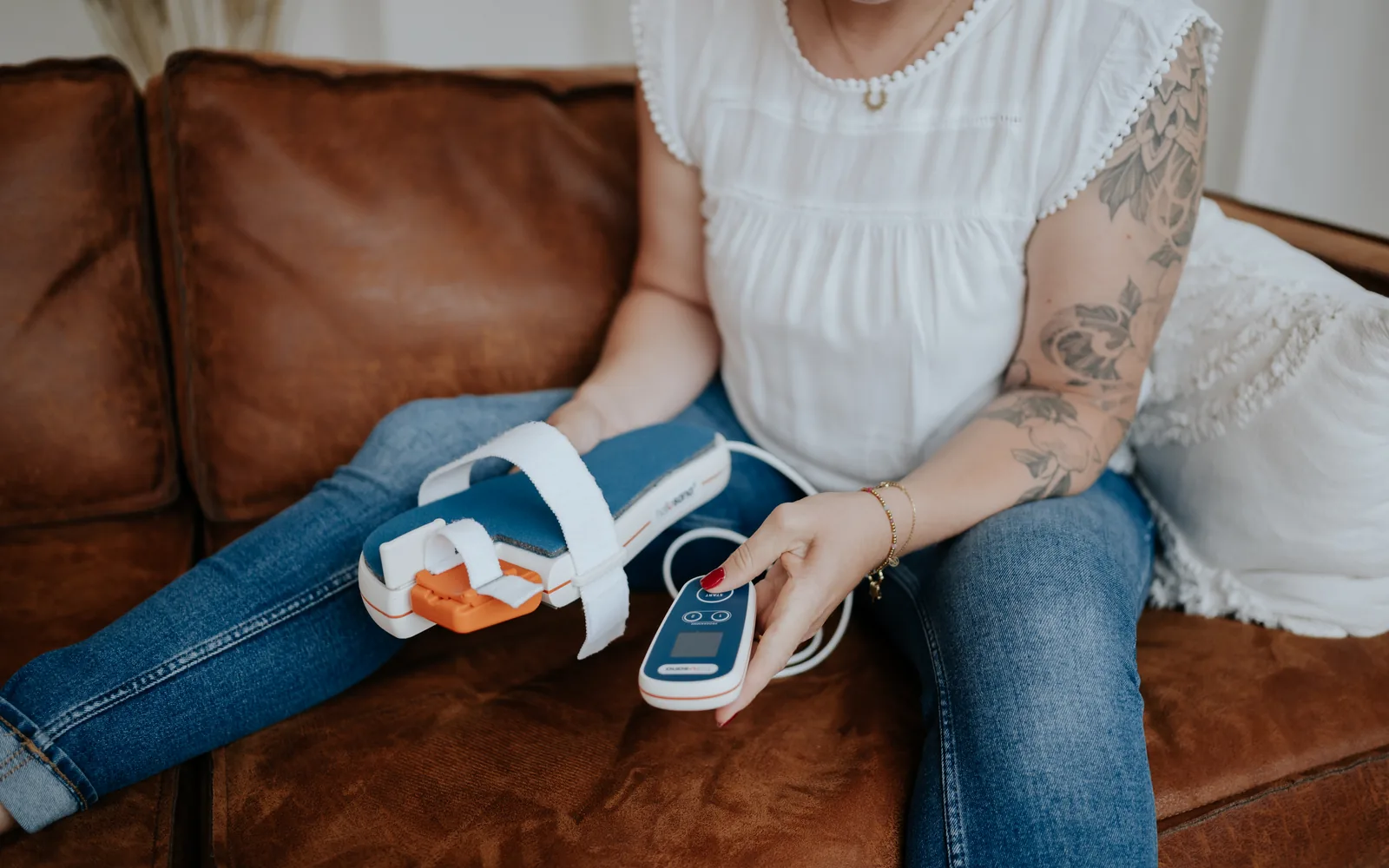
Three things help to achieve satisfactory mobility in all directions: precise instructions for your own movement exercises, physiotherapy and a motorised motion splint (CPM).
Passive motion at home after surgery
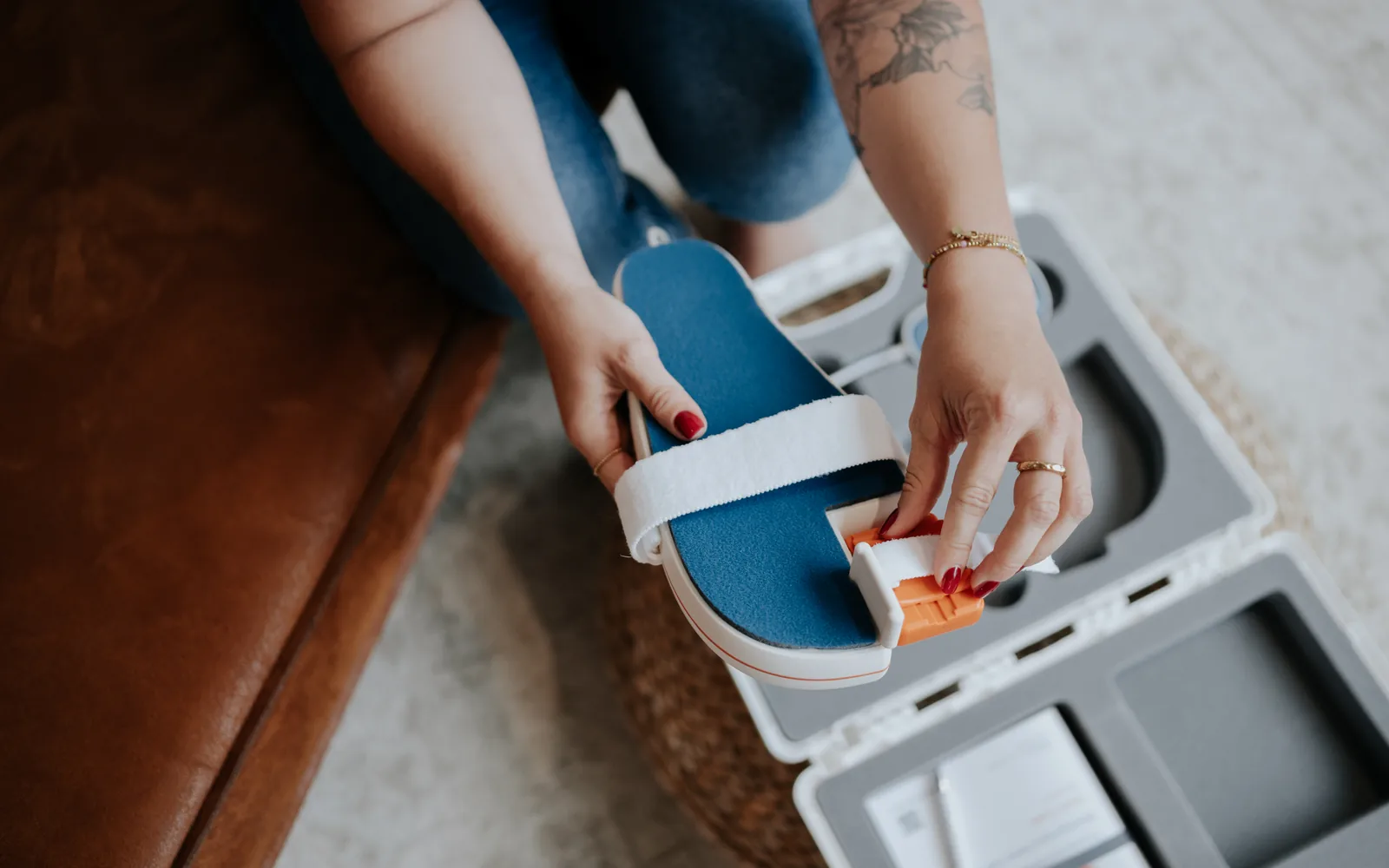
The Hall-U-Sana® toe CPM device moves the big toe joint with a motor and without any effort on your part: programme 1 for the phase directly after surgery with 20 degrees up and 10 degrees down, programme 2 for the later phase with 40 and 20 degrees, each for 25 minutes twice a day while sitting. There is nothing to set: you place your foot in the device and start the programme. Hall-U-Sana® is a Class IIa medical device (CE) for rehabilitation after surgery on the first ray. It is available to rent through distribution partners in Germany, Switzerland and France, see Sources of supply, and the studies are on the studies page. It is not cleared by the FDA and is not available in the United States. Whether and from when the device makes sense after your operation is decided by your surgeon.
Which signs need to be checked straight away?
Swelling, a feeling of pressure and pain on loading that get better when you raise the foot are normal. The following are not normal, from the day they appear:
- Increasing redness, warmth and swelling around the wound, discharge or pus, fever or chills: signs of a wound infection, which affects about one in a hundred patients.
- Throbbing, worsening pain or a pulse you can feel in the foot after the first days were calm.
- Swelling that does not go down despite raising the foot, or new numbness and abnormal sensations.
- Widespread pain in the calf, a feeling of tightness, warm reddened skin on one side: suspected thrombosis; sudden shortness of breath, chest pain when breathing in, a racing heart or fainting are an emergency, then call 112 (in the UK also 999).
- A toe that is suddenly crooked again, or a click with new pain: screws that do not hold need a prompt check and, where necessary, appropriate further treatment.
The risk of thrombosis after forefoot procedures with immediate weight-bearing is very small at 0.05%, and it rises with immobilisation, which is why your surgical team decides how long the injections continue (Malhotra et al. 2024).
Is recovery different after hallux rigidus surgery?
Yes, in both directions: after a cheilectomy, in which only the bony outgrowths on the joint are removed, the foot can bear weight straight away, the post-op shoe stays on for between two and six weeks, and exercises begin early, because mobility is the aim of the operation; the details are in the guide to cheilectomy. After a fusion of the big toe joint, recovery takes longer: offloading shoe for six to eight weeks, stitches out after three weeks, X-ray after six weeks, swelling for four to six months, jogging after about three months, according to the Universitätsklinik Balgrist; the Gelenk-Klinik Gundelfingen does not allow rolling through over the joint during the six to eight weeks the bone takes to fuse and then recommends flat shoes with a stiffening insole for three to six months. In studies, bony fusion takes six to ten weeks on average; with early weight-bearing it was reached clinically after 5.6 weeks and on X-ray after 6.1 weeks (Coughlin et al. 2005, Dayton and McCall 2004). During this time it is not the fused big toe joint that is moved, but the end joint of the toe, in Bamberg from the day of surgery.
Conclusion
Two weeks for the wound, six to eight weeks for the bone, three to six months for the swelling, up to a year for mobility: if you know these four clocks, you understand your foot. Week 8, with a swollen foot and pain on loading, is readjustment, not a setback. Redness, fever, calf pain and suddenly new pain are the exceptions that need to be seen by your surgical team straight away. And the one question you should ask before the operation is not how long the shoe stays on, but from when the joint will be moved, because that is where it is decided how mobile the toe will be after a year.
Frequently asked questions about recovery after bunion surgery
How long do you stay in hospital after bunion surgery?
In the German and Swiss clinics cited here, between none and three nights, depending on the procedure and the clinic. Klinikum Bamberg usually operates as a day case, the Balgrist keeps patients for one to two nights, Aarau for two to three, until the wound is dry and walking in the post-op shoe works safely; after a Lapidus fusion it is usually three days. A longer stay is only needed with other medical conditions or if there is severe swelling.
How long should you keep your foot up after bunion surgery?
Consistently in the first two weeks, in Meerbusch for four weeks higher than the knee, every time you sit or lie down; the review gives two weeks. After that, the rule of thumb is: as soon as the foot swells or hurts after activity, put it up until the swelling has gone down. This lowers the pressure in the tissue and with it the pain, and it remains the most effective remedy for the swelling into the third month.
Why does my foot still hurt eight weeks after bunion surgery?
Because it is relearning. After eight weeks, the big toe carries about half of the load when you walk that it carries after six months, and the foot is switching back from walking through the heel to rolling through. The capsule, tendons and ligaments stay sensitive for three to six months, and the swelling comes back in the evening. Pain on loading is normal in this phase; new, throbbing or night-time pain needs to be checked by your surgical team.
Why do I still have pain a year after bunion surgery?
There is usually something that can be named behind it: pain under the neighbouring toes from load that has shifted, screws that press, bone that has not healed, a recurrence or nerve irritation. Across all procedures, the complication rate is 18.5%. If you still have symptoms after twelve months, you need an X-ray and an examination by your surgical team; much can be solved with insoles, physiotherapy or a minor removal of the hardware.
What is a Kramer dressing after bunion surgery, and how long does it stay on?
A corrective dressing: gauze bandages or strips of adhesive tape that hold the big toe in the corrected position with a gentle inward pull while the capsule and scar firm up. The surgeon applies it on the day of surgery, after which it is renewed at follow-up appointments or at home, usually until week 6, in some places supplemented by a night splint or a toe splint. It does not replace the post-op shoe but is worn underneath it.
About the author: Dr Franz Freuler is a Specialist in Orthopaedic Surgery FMH. In 2005 he built the first prototype of a motorised continuous passive motion device for the big toe joint, which became the Hall-U-Sana®. He is co-founder and CTO of U-Sana Medical AG in Oberwil near Basel.
This guide provides general information and does not replace a medical examination. The times that apply to your recovery are set out in the aftercare plan of your surgical team.
Sources
- Ettinger S, Spindler FT, Marschall U, Polzer H, Stukenborg-Colsman C, Baumbach SF. Hallux valgus: prevalence and treatment options. Dtsch Arztebl Int 2025;122:308-314. PubMed 40332014
- Wülker N, Mittag F. The treatment of hallux valgus. Dtsch Arztebl Int 2012;109:857-867. PubMed 23267411
- Frigg A, Zaugg S, Maquieira G, Pellegrino A. Stiffness and range of motion after minimally invasive chevron-Akin and open scarf-Akin procedures. Foot Ankle Int 2019;40:515-525. PubMed 30688526
- Schuh R, Hofstaetter SG, Kristen KH, Trnka HJ. Effect of physiotherapy on the functional improvement after hallux valgus surgery: a prospective pedobarographic study. Z Orthop Unfall 2008;146:630-635. PubMed 18846491
- Schuh R, Hofstaetter SG, Adams SB, Pichler F, Kristen KH, Trnka HJ. Rehabilitation after hallux valgus surgery: importance of physical therapy to restore weight bearing of the first ray during the stance phase. Phys Ther 2009;89:934-945. PubMed 19608631
- Connor JC, Berk DM, Hotz MW. Effects of continuous passive motion following Austin bunionectomy. A prospective review. J Am Podiatr Med Assoc 1995;85:744-748. PubMed 8592286
- Akeson WH, Amiel D, Abel MF, Garfin SR, Woo SL. Effects of immobilization on joints. Clin Orthop Relat Res 1987;219:28-37. PubMed 3581580
- Singh SK et al. Chevron osteotomy with suture stabilization for hallux valgus: a prospective study. J Foot Ankle Surg 2004;43:307-311. PubMed 15480406
- Schnepp T et al. Radiographic union after minimally invasive transverse osteotomy and Akin for hallux valgus: 217 cases. Foot Ankle Orthop 2025;10(3). PubMed 40656444
- Einhorn TA. The cell and molecular biology of fracture healing. Clin Orthop Relat Res 1998;355 Suppl:S7-21. PubMed 9917622
- Nawoczenski DA, Baumhauer JF, Umberger BR. Relationship between clinical measurements and motion of the first metatarsophalangeal joint during gait. J Bone Joint Surg Am 1999;81:370-376. PubMed 10199275
- Spencer L et al. Complications after elective foot and ankle surgery: a systematic review. J Foot Ankle Res 2026;19:e70235. PubMed 42894440
- Sieloff MR et al. Complications of scarf osteotomy for hallux valgus: a systematic review and meta-analysis. J Foot Ankle Surg 2023;62:610-617. PubMed 37097272
- Rewhorn MJ, Leung AH, Gillespie A, Moir JS, Miller R. Incidence of complex regional pain syndrome after foot and ankle surgery. J Foot Ankle Surg 2014;53:256-258. PubMed 24613278
- Plaass C, Reifenrath J, Richter A. Hardware removal after hallux valgus surgery. Foot Ankle Clin 2025;30:269-283. PubMed 40348460
- Coughlin MJ, Grebing BR, Jones CP. Arthrodesis of the first metatarsophalangeal joint for idiopathic hallux valgus: intermediate results. Foot Ankle Int 2005;26:783-792. PubMed 16221449
- Dayton P, McCall A. Early weightbearing after first metatarsophalangeal joint arthrodesis: a retrospective observational case analysis. J Foot Ankle Surg 2004;43:156-159. PubMed 15181431
- Wust M et al. PROSPECT guideline for hallux valgus surgery: a systematic review and procedure-specific postoperative pain management recommendations. Eur J Anaesthesiol 2026;43:11-18. PubMed 41122054
- Genuth G et al. Recurrence after combined minimally invasive osteotomies for hallux valgus by severity at 12 months. Foot Ankle Orthop 2026;11(3). PubMed 42633001
- Malhotra K, Houchen-Wolloff L, Mason L, Mangwani J. Characteristics of patients not receiving chemical thromboprophylaxis following foot and ankle surgery (UK-FATE). Foot Ankle Int 2024;45:943-949. PubMed 38872313; McDonald E, Shakked R, Daniel J, Pedowitz DI, Winters BS, Reb C, Lynch MK, Raikin SM. Driving after hallux valgus surgery. Foot Ankle Int 2017;38:982-986. PubMed 28608725
- Ärztliches Zentrum für Qualität in der Medizin (ÄZQ) on behalf of the German Medical Association and the National Association of Statutory Health Insurance Physicians: Short information on surgical wounds, August 2022 (PDF, in German). bundesaerztekammer.de
- Institut für Qualität und Wirtschaftlichkeit im Gesundheitswesen (IQWiG), gesundheitsinformation.de: Deep vein thrombosis (DVT), as of 27 May 2026 (in German). gesundheitsinformation.de
- Institut für Qualität und Wirtschaftlichkeit im Gesundheitswesen (IQWiG), gesundheitsinformation.de: Surgery for hallux valgus, as of 9 October 2024 (in German). gesundheitsinformation.de
- DocCheck Flexikon: Fracture healing, phases and time course (medical reference work, in German). flexikon.doccheck.com
- Kantonsspital Olten, Dr. med. Sandra Meier, Dr. med. Katharina Cichon: Hallux valgus, patient information (PDF, in German). solothurnerspitaeler.ch
- Universitätsklinik Balgrist Zürich: Hallux valgus, distal metatarsal osteotomy, patient information (PDF, in German). balgrist.ch
- Universitätsklinik Balgrist Zürich: Fusion of the big toe joint, patient information (PDF, in German). balgrist.ch
- Klinikum Bamberg, Prof. Dr. med. Peter Strohm, Dr. med. A. Saal: Aftercare plan for fusion of the big toe joint (PDF, 02/2023, in German). sozialstiftung-bamberg.de
- Klinikum Bamberg, Prof. Dr. med. Peter Strohm, Dr. med. A. Saal: Aftercare plan for Lapidus arthrodesis (PDF, 02/2023, in German). sozialstiftung-bamberg.de
- Märkische Kliniken Lüdenscheid: Aftercare for hallux valgus, 05/2020 (PDF, in German). maerkische-kliniken.de
- Klinikum Kassel, Klinik für Unfallchirurgie, Prof. Dr. Clemens Dumont: Aftercare plan for hallux valgus surgery (PDF, 12/2022, in German). gesundheit-nordhessen.de
- Universitätsklinikum Münster, Klinik für Unfall-, Hand- und Wiederherstellungschirurgie, Prof. Dr. Sabine Ochman: Aftercare plans for hallux valgus forefoot surgery (PDF, 10/2023, in German). ukm.de
- Kantonsspital Aarau, Klinik für Orthopädie und Traumatologie: Patient information on hallux valgus treatment (PDF, in German). ksa.ch
- St. Elisabeth-Hospital Meerbusch, Fußchirurgisches Zentrum, Dr. Robert Van Ende: Aftercare after foot surgery, patient brochure (PDF, in German). rrz-meerbusch.de
- Orthozentrum Cham, Dr. med. Rolf F. Oetiker: The time after foot surgery, information sheet (PDF, in German). orthozentrum.ch
- Fußchirurgie Berlin, Dr. med. Tonio Gottlieb: Hallux valgus surgery, procedure and aftercare (in German). der-fusschirurg.de
- ORTHO PEDE Berlin, Dr. med. Stefan Böhr: Pain after hallux valgus surgery, what is normal and what is not, 17 February 2026 (in German). ortho-pede.de
- Schön Klinik, Prof. Dr. Markus Walther: Hallux valgus, treatment, and hallux rigidus, treatment (in German). schoen-klinik.de
- Gesellschaft für Fuß- und Sprunggelenkchirurgie e.V. (GFFC): Patient information on hallux valgus; Fußchirurg Hannover, Dr. med. Ryszard van Rhee: General information on the operation (in German). gesellschaft-fuer-fusschirurgie.de
- Hôpitaux Universitaires de Genève, Prof. Didier Hannouche: Hallux valgus, what complications are possible (in French). hug.ch
- Sana Krankenhaus Hürth, Dr. med. Marc Goebel: Scar treatment after surgery, patient leaflet 08/2026 (PDF, general rules on scars, not a foot-specific source, in German). sana.de
- Gelenk-Klinik Gundelfingen, Dr. med. Thomas Schneider, Dr. med. Martin Rinio: Arthrodesis for hallux rigidus, and joint-preserving surgery for hallux rigidus (in German). gelenk-klinik.de
Sources as of 2 November 2026. The online sources were accessed on this date, and the studies are linked via PubMed.