
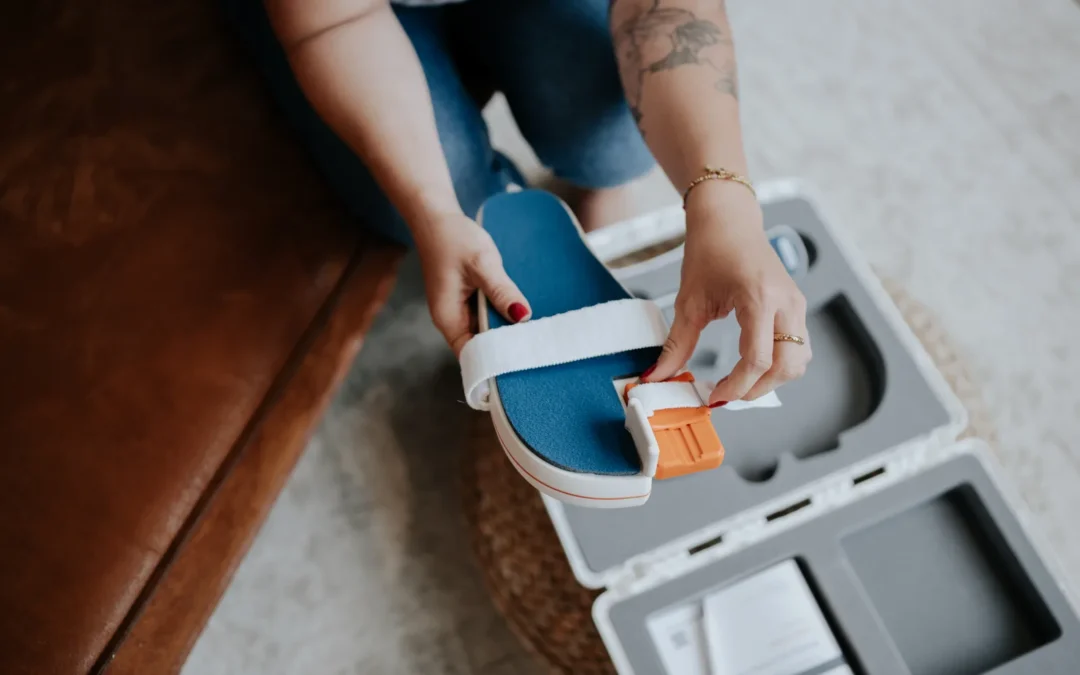
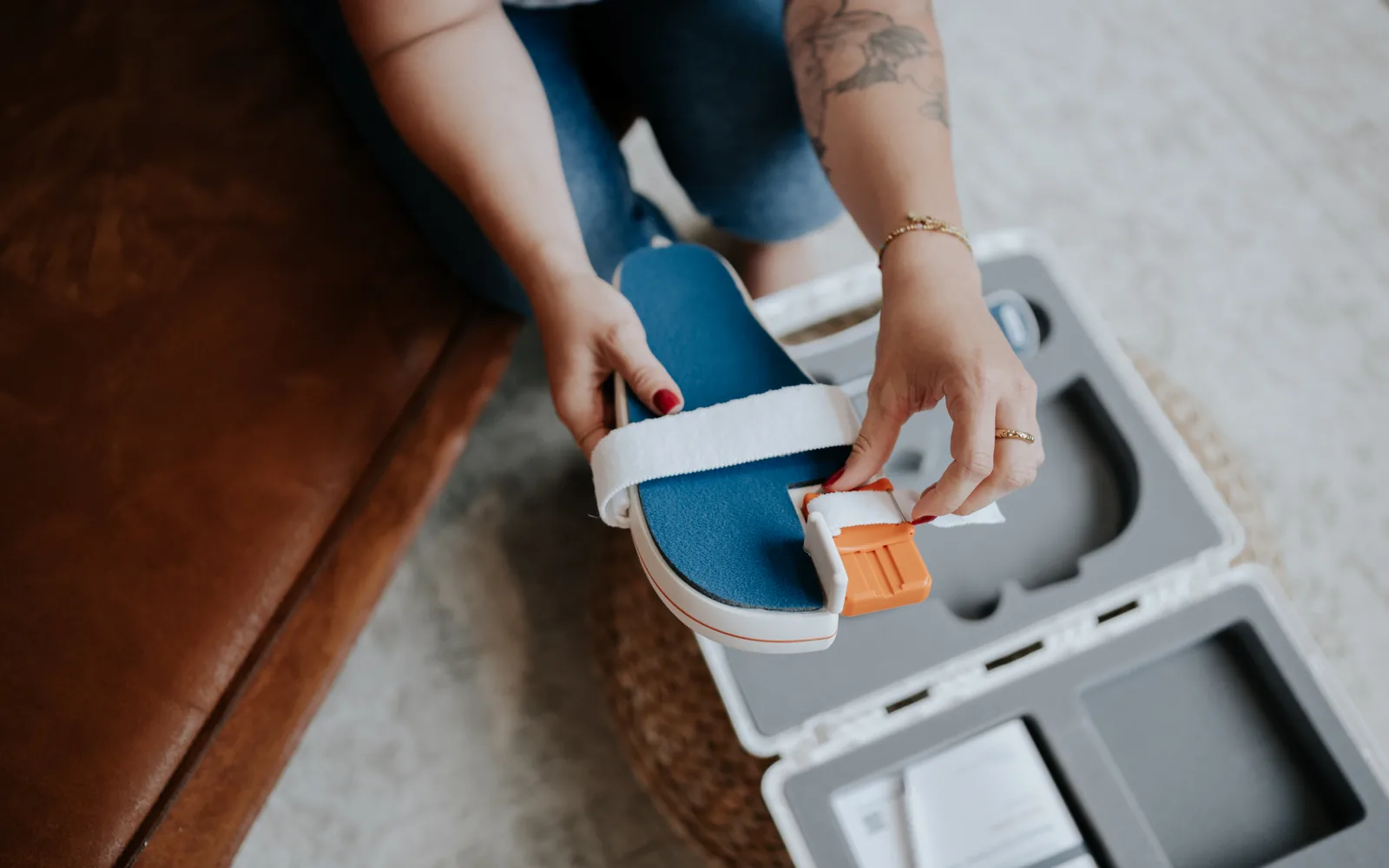
A CPM machine, or continuous passive motion (CPM) device, is a motor-driven device that slowly bends and straightens an operated joint without your own muscle power, so it stays mobile in the first weeks after surgery (passive motion). On the big toe joint (first metatarsophalangeal joint) it raises and lowers the big toe, twice a day for 25 minutes, seated. It is not a bunion splint from the chemist: that holds the toe still, the motorised splint moves it.
Contents
- What is a CPM device, and where does the idea come from?
- How does a CPM device work on the big toe joint?
- What are the benefits of a CPM machine after bunion surgery?
- Is a CPM device the same as a bunion splint?
- When and for how long is the CPM device used?
- How do you operate the CPM device?
- Is the CPM device complicated to use?
- Who prescribes a CPM device, and does health insurance pay?
- How does the CPM device get to your home?
- Conclusion
- Frequently asked questions about CPM devices
- Sources
What is a CPM device, and where does the idea come from?
The German statutory health insurers’ directory of medical aids (Hilfsmittelverzeichnis) describes the device in sober terms: an externally powered movement device for the continuous, programmed, passive movement of joints. A motor moves the joint through a set range, in a set direction and for a set time, and the doctor specifies the values. In everyday language the device is also called a CPM machine or motorised motion splint; the abbreviation CPM stands for continuous passive motion. Passive means that the patient does nothing and the motor does the work. This distinguishes the treatment from physiotherapy and your own exercises, in which your own muscles or the therapist’s hands move the joint.
The idea comes from Toronto. Around 1970 the orthopaedic surgeon Robert Salter observed that immobilisation harms joints, and he put forward the opposite thesis: continuous, gentle movement protects cartilage and capsule. In his animal experiments, cartilage defects healed with genuine joint cartilage in 52% of cases under continuous motion, but in only 8% under immobilisation (Salter et al. 1980). In 1978 the first devices for humans were built, initially for the knee, hip and elbow (Salter 1989). CPM devices were added to the German directory of medical aids in 1996; after being removed and reassessed, only knee and shoulder devices have been listed there since 2012.
How does a CPM device work on the big toe joint?
After an operation, a joint that is kept still passes through four stages before it becomes stiff: bruising, swelling, granulation tissue, scar. In the first two stages passive motion works like a pump that drives blood and swelling fluid out of the joint and its surroundings, so the soft tissue stays supple. Stiffness can only be prevented if the movement starts early and continues until the swelling stops increasing (O’Driscoll and Giori 2000). Immobilisation, on the other hand, makes the capsule and ligaments lose collagen; in animal experiments the load-bearing capacity of the ligaments fell to about a third (Akeson et al. 1987).
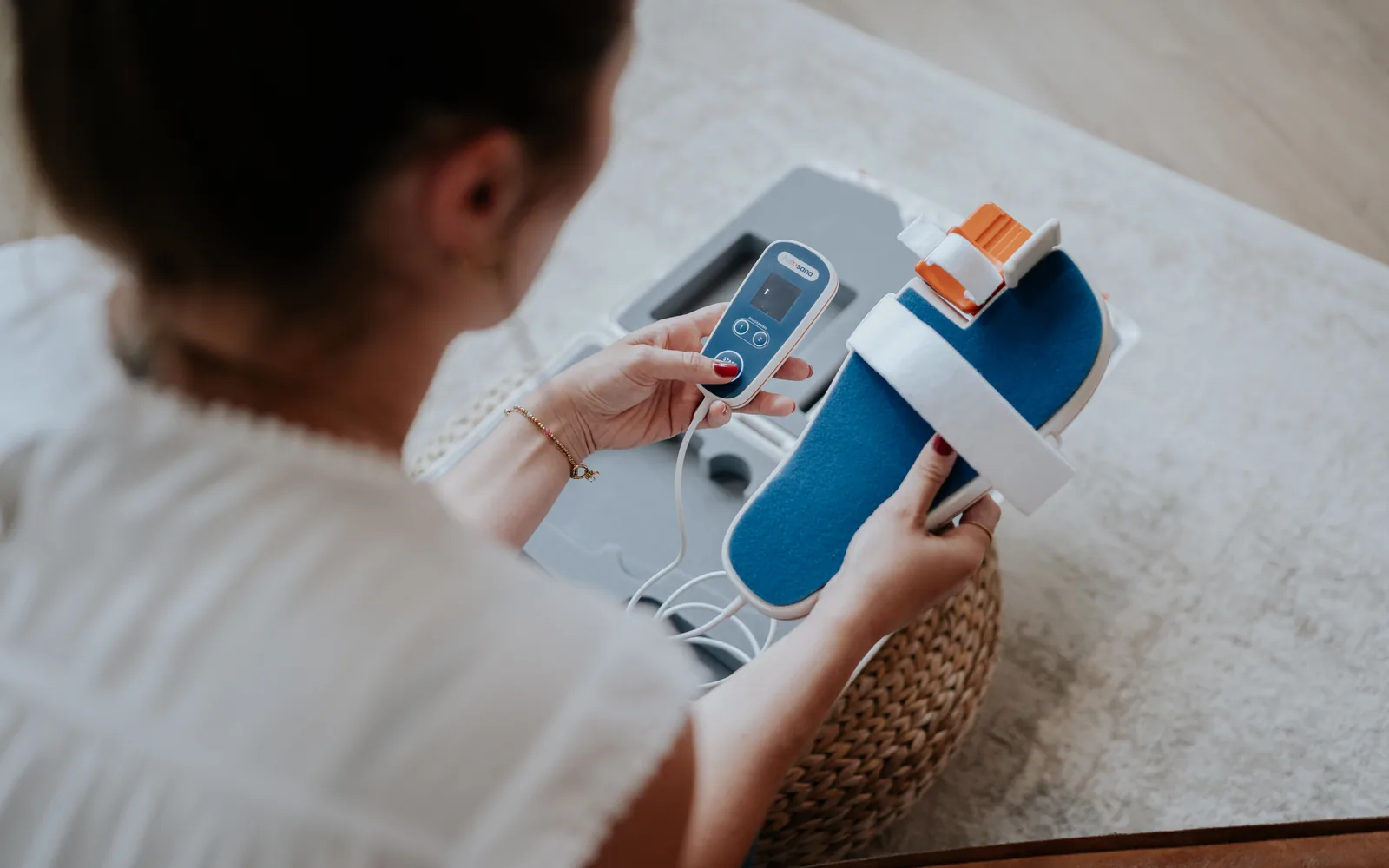
On the foot, this is how it looks on the motion splint: the foot rests on a sole, an instep strap and a toe strap with hook-and-loop fastening hold it in place, and a padded toe separator makes sure that the big toe joint lies exactly in front of the pivot axis of the moving toe flap. The motor raises and lowers the flap at 3 degrees per second, slowly enough that nothing jerks. The Hall-U-Sana® works with two fixed programmes whose angles were set together with orthopaedic foot specialists:
| Programme | Up (extension) | Down (flexion) | Recommended phase |
|---|---|---|---|
| Programme 1 | 20 degrees | 10 degrees | the first 4 to 5 days of treatment |
| Programme 2 | 40 degrees | 20 degrees | from day 5 to day 30 |
Each programme begins with a start-up phase: the angle increases by 5 degrees with each up-and-down movement until the full range is reached. If pain occurs with programme 2, treatment continues with programme 1 for a few days. There are no other settings, and that is intentional: the fixed end angle prevents the toe from being moved too far, which with movement by hand depends on the skill of the person doing it. How long the two treatment phases last also depends on the local conditions at the operated joint.
What are the benefits of a CPM machine after bunion surgery?
The honest answer has two parts, because the evidence differs from joint to joint.
For the knee after joint replacement, the benefit is disputed today. The 2014 Cochrane review summarised 24 randomised trials with 1,445 patients: 2 degrees more bending, no noticeable difference in pain and function, and the authors see no reason for routine use (Harvey et al. 2014). In a 2016 expert report for the German health insurers, the Medical Service (Medizinischer Dienst) came to the same conclusion: physiotherapy remains the standard, and the splint can neither replace nor shorten it.
The big toe joint is a different case, because the problem is a different one. After bunion (hallux valgus) correction the joint remains stiff in 7 to 38% of patients, and the minimally invasive technique does not change this (Frigg et al. 2019). The only randomised trial on passive motion of this joint comes from the USA: 39 patients after a chevron osteotomy (Austin), 18 with physiotherapy only, 21 who in addition used a motorised splint from the day of surgery for eight hours a day over 24 days. The splint group was more mobile at every follow-up visit from day 7 to day 90, returned to normal shoes sooner and stopped taking painkillers sooner (Connor et al. 1995). The same group treated ten patients whose joint had already become stiff after an earlier operation, for four weeks at least four hours a day: mobility improved in seven out of ten, and three still needed a further operation (Connor and Berk 1994). Both studies used a different device from the Hall-U-Sana®. The Cochrane review on hallux valgus assessed four rehabilitation studies with 162 participants and noted that passive motion improved the range of movement and early recovery; the review has not been updated since 2009 (Ferrari et al. 2004). Physiotherapy also shows that movement after surgery counts: with exercises from the fourth week, the function score rose from 60.7 to 94.5 points within six months (Schuh et al. 2009).
What follows from this, without exaggeration: one randomised trial with 39 patients is a narrow basis, but it is the only one there is, and it comes out in favour of movement. The German S2e guideline on hallux valgus names passive and active exercise of the big toe joint as part of aftercare, without a time point and without a device. Clinics interpret this very differently: Klinikum Bamberg starts passive physiotherapy of the big toe joint on the day of surgery, the St. Elisabeth-Hospital Meerbusch has the toe joints moved passively up to the pain threshold after surgery, the Marienhospital Stuttgart requires eight weeks without movement in the big toe joint, and Klinikum Kassel does not consider mobility exercises useful until week 12. Whether and from when your joint should be moved is therefore decided by your surgeon, not by this text.
From the author’s own practice: even with the original prototype of the splint presented here, built in 2005, we observed a considerable improvement in big toe function in our patients compared with the previous treatment. This observation has not been systematically documented.
Is a CPM device the same as a bunion splint?
No, even though both are called a “splint” in everyday language. The bunion splint from the chemist or online shop (night splint, corrective splint, toe spreader) is a rigid or elastic aid that pushes or holds the big toe towards a straight position. What it can do has been measured: a review of nine studies found that orthoses with a toe separator change the deformity angle by a few degrees (Kwan et al. 2021). In 30 women who wore a night splint or an insole with a toe separator for three months, the angle did not change in either group, and only the insole reduced pain (Tehraninasr et al. 2008). And in a direct comparison of 209 patients, after one year 83% of those operated on felt better, 46% of those with an orthosis and 24% of those without treatment (Torkki et al. 2001). After surgery, some clinics use a night splint as a positioning splint to hold the correction for six weeks or longer.
| Bunion splint | CPM device (motorised splint) | |
|---|---|---|
| What it does | holds or pulls the toe in one direction | moves the toe up and down, without pulling |
| When | before surgery or for positioning afterwards | only after surgery |
| Drive | none, strap or spring | motor with battery |
| How you get it | freely available | only on medical prescription |
| Aim | relieve the deformity, hold the correction | maintain joint mobility and the corrected position |
So the motorised splint does not correct anything, and the night splint does not move anything. If you are given both after surgery, you wear one at night for positioning and use the other during the day while sitting.
When and for how long is the CPM device used?
The Hall-U-Sana® instructions for use set the framework: treatment only once wound healing is well advanced, depending on progress at the earliest two weeks after surgery; twice a day for 25 minutes over 30 days, and the treating doctor can prescribe more sessions a day or let programme 1 run for longer. In the American study, movement began on the day of surgery, at eight hours a day. Which time is right for you depends on the procedure, the wound and your practice’s aftercare plan, and that is where it is decided.
The device is used while sitting, with the splint lying flat on the floor, preferably not on a deep-pile carpet. Lying down, standing or walking during treatment is not permitted, because the angle is then no longer correct and the flap may jam. During this time the post-op shoe remains responsible for walking and protects the bone; the splint looks after the joint while you sit.
The device is intended for aftercare following operations on the first ray: hallux valgus and hallux rigidus procedures, surgically treated cartilage defects and fractures, joint replacement. It must not be used in the case of inflamed skin under the straps, very thin skin, for example after long-term cortisone treatment, unstable fractures, acutely inflamed joints as in gout, infection of the big toe joint, intolerance of mobilisation and severe swelling. When used as intended, no side effects are known; if pain persists, the treatment should be interrupted and your practice consulted.
How do you operate the CPM device?
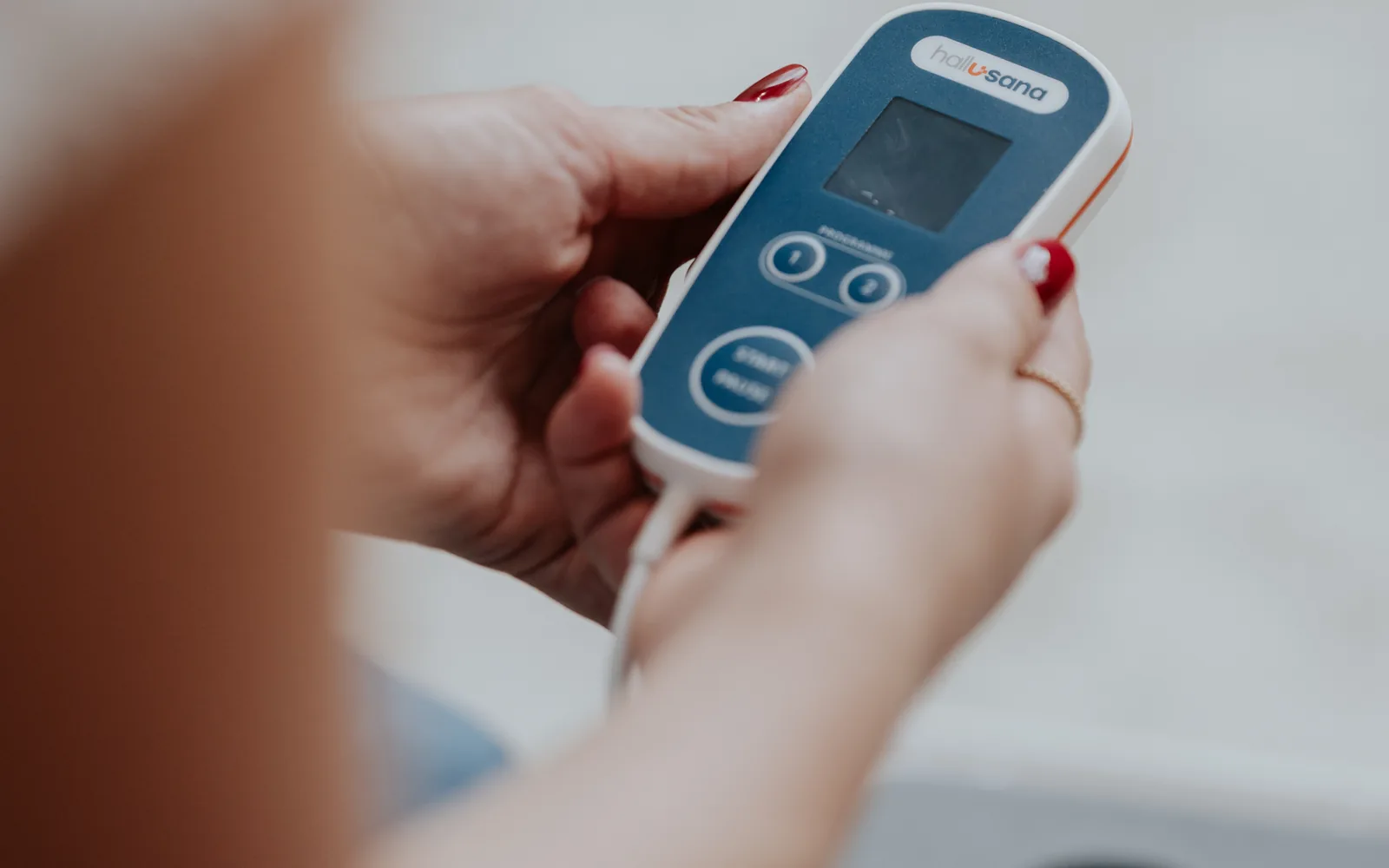
In the instructions for use, the procedure is divided into a few steps:
- Sit down, place the splint flat on the floor, push your foot forward until the fold between the big toe and the second toe rests against the padded toe separator. No pressure on the scar.
- Close the instep strap and the toe strap with the hook-and-loop fastener, firmly enough that the toe moves with the flap, loosely enough that nothing constricts.
- Switch on the control unit: hold the start button for two seconds. Programme 1 is preselected, button 2 switches to programme 2.
- Press the start button. The light ring turns green and the display counts down the 25 minutes.
- If there is pain or something slips: press the start button again. The flap moves to the horizontal starting position, the display flashes “PAUSE” and the time stops. Pressing again resumes the programme.
- After 25 minutes “END” appears, the flap moves back and the device switches itself off after five minutes.
Two safety functions run in the background: if the flap meets resistance, for example because something is trapped at the side, it immediately moves to the starting position and shows an overload symbol. The battery is charged for the entire 30-day treatment period, so you do not recharge anything; if the display shows 33% or less, the service partner sends a replacement device. It is cleaned with a damp cloth, never under running water, and between uses the splint is stored in its case.
Is the CPM device complicated to use?
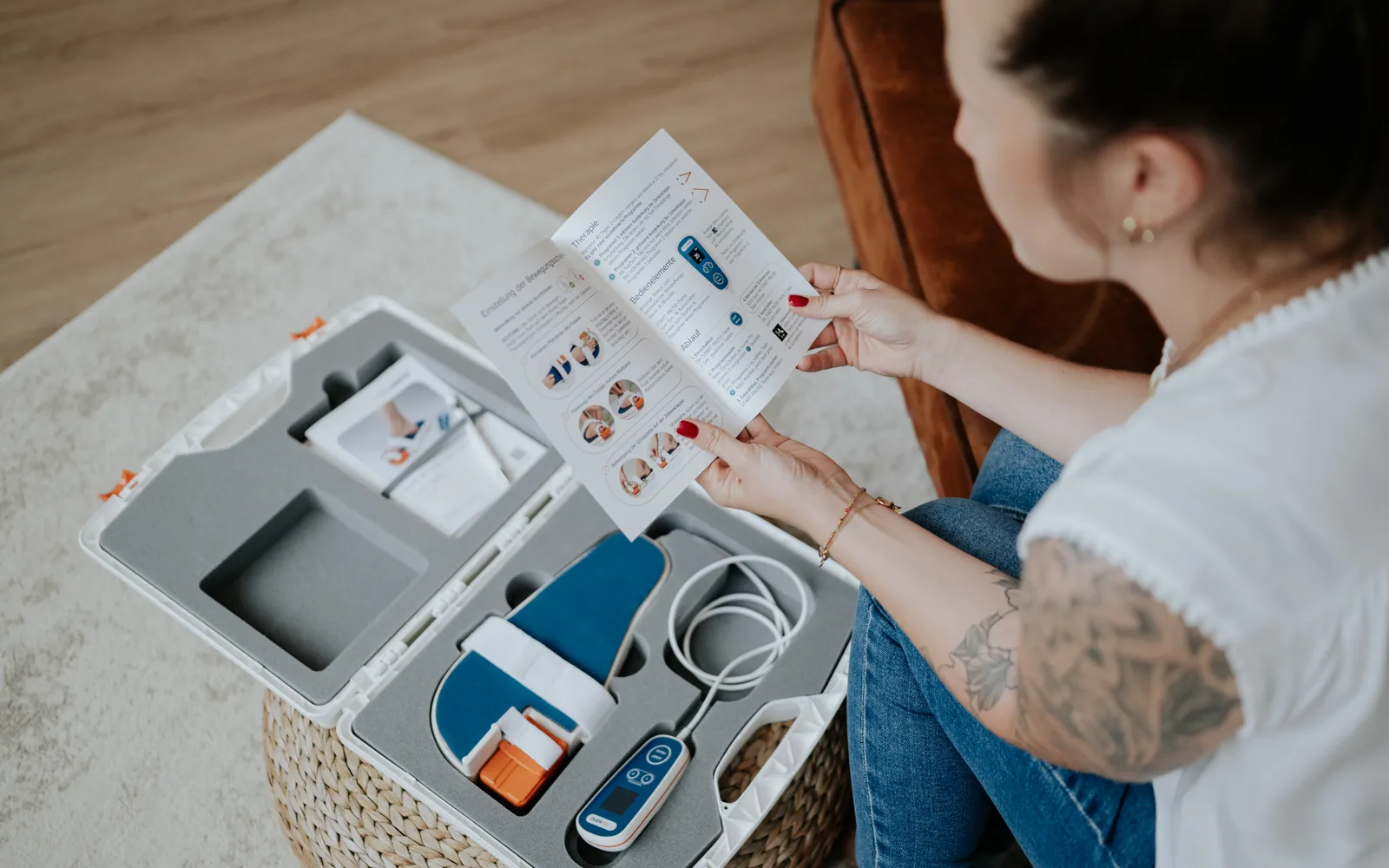
No. The device was built so that only minimal adjustment is needed, which patients carry out themselves after a short self-study, as stated in the instructions for use. There are three buttons, two programmes and no setting that you can get wrong; an illustrated quick guide is included in the case. The instructions for use also say what to do about typical problems: if the toe does not move properly with the flap, the foot is not far enough forward or the straps are too loose. If severe pain occurs, the pause helps, then a new attempt after 15 to 20 minutes, and with programme 2 a switch back to programme 1; if the pain persists, stop and call the service partner. Anyone with impaired perception or mobility should only use the device with a companion who keeps an eye on things.
Who prescribes a CPM device, and does health insurance pay?
The following information applies to Germany and Switzerland. In other countries, ask your health insurer before you order.
In Germany, any doctor contracted to the statutory health insurance may prescribe medical aids, including your GP, provided they have satisfied themselves of the patient’s condition; usually, though, the surgical practice issues the prescription, because it knows the aftercare plan. Medical aids are prescribed on form 16, the pink prescription, with code number 7, and must be presented to a supplier within 28 days. The Hall-U-Sana® instructions for use expressly require a medical prescription.
Whether German statutory health insurance pays depends on the joint. The directory of medical aids lists only the knee motion splint and the shoulder motion splint, and even these only if physiotherapy and your own exercises are not expected to secure the range of movement on their own; the insurer then lends the device, usually for two to four weeks and at most six, with a co-payment of five to ten euros. There is no entry in the directory for the big toe joint, and according to the insurers, motorised splints for other joints are generally not covered. That leaves three routes. An individual application with a medical prescription, on which the insurer must decide within three weeks, or within five if an expert opinion is obtained, otherwise the benefit is deemed approved. Private health insurance reimburses according to the policy, and the allowance scheme for civil servants (Beihilfe) expressly lists the motion splint as an eligible medical aid. Or renting as a self-payer through the distribution partner. In Switzerland, the route is a medical prescription and the rental pool of Lüdi Medical; the device arrives at your home within 48 hours, and a technician fits it and explains it.
One thing applies in every country: the splint does not replace physiotherapy or your own exercises, it provides additional support.
In Switzerland, basic health insurance does not pay for the rental: the list of aids and appliances (MiGeL) of the Federal Office of Public Health includes only the shoulder among the motorised motion splints. For the accident insurers, their tariff commission has recommended since 2021 that motorised splints at home should no longer be paid for. Whether a supplementary insurance covers anything depends on the individual policy; ask before you order.
How does the CPM device get to your home?
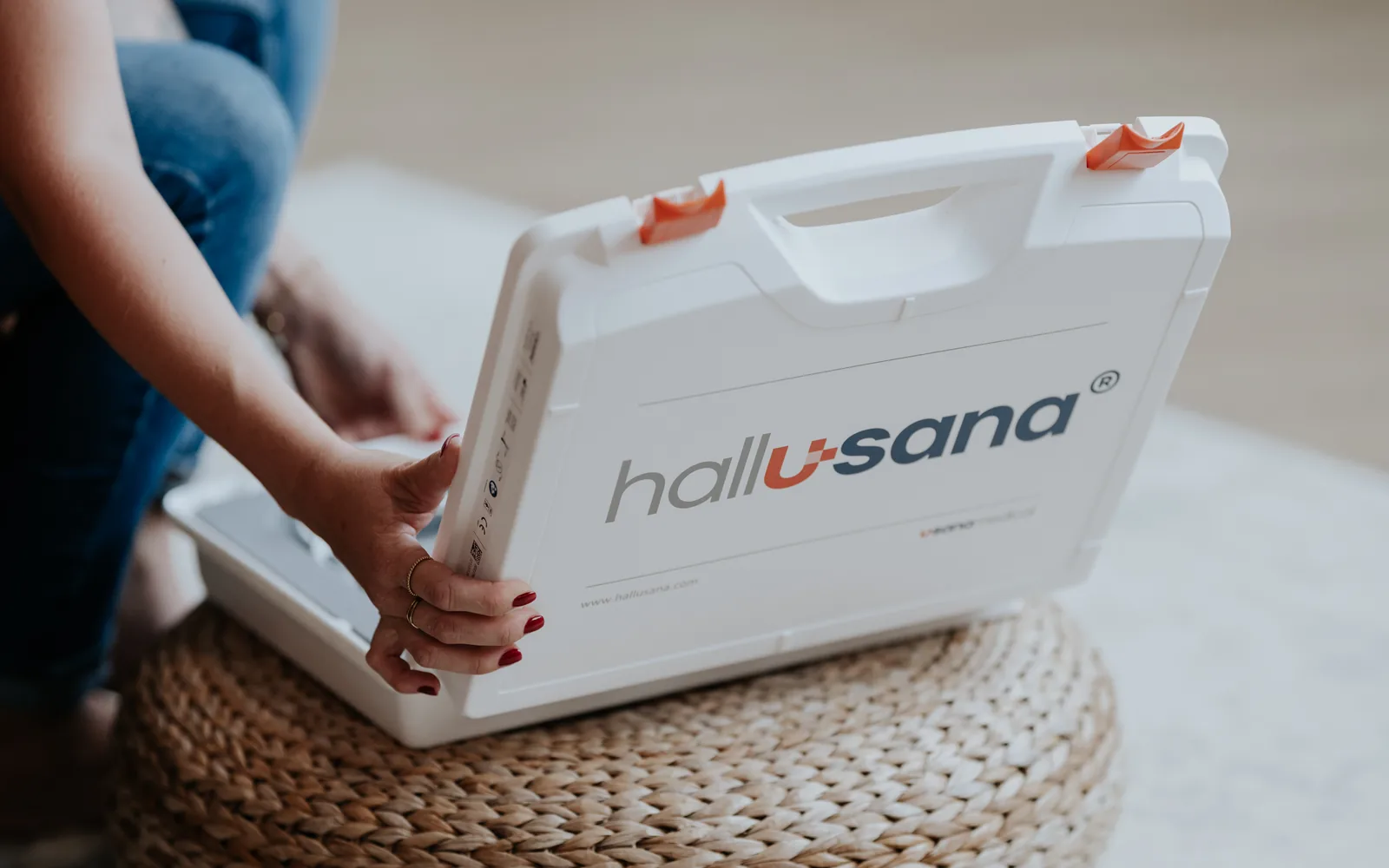
The route is the same in every country, only the partner changes. Your practice recommends or prescribes the device, ideally before the operation, so that it is ready when treatment starts. You order from the distribution partner in your country: in Germany via the order form on this website (in German), with a medical supply shop arranging the rental, in Switzerland via Lüdi Medical, in France via Medirent; which address applies to you is shown on the Sources of supply page. You receive a case with the splint, control unit, cable and quick guide, and the battery is charged. When treatment is over, you contact the service partner, keeping the transport box for this purpose, and send the device back. One device for a whole treatment window: no purchase, no maintenance, nothing to charge.
Passive motion at home after surgery
The Hall-U-Sana® toe CPM device moves the big toe joint with a motor and without any effort on your part: programme 1 for the phase directly after surgery with 20 degrees up and 10 degrees down, programme 2 for the later phase with 40 and 20 degrees, each for 25 minutes twice a day. There is nothing to set: you place your foot in the device and start the programme. Hall-U-Sana® is a Class IIa medical device (CE) for rehabilitation after surgery on the first ray. It is available to rent through distribution partners in Germany, Switzerland and France, in Switzerland on medical prescription via Lüdi Medical; details are on the Sources of supply page, and the studies are on the studies page. It is not cleared by the FDA and is not available in the United States. Whether and from when the device makes sense after your operation is decided by your surgeon.
Conclusion
A motorised splint does one single thing: it moves the operated joint, day after day, with a fixed angle and without your own effort. For the big toe joint, the only randomised trial speaks in its favour, and the stiffness figures after correction show why the joint needs attention. Do not confuse the device with the bunion splint from the shop, which holds instead of moving. Prescription, start time and duration are set by your surgeon; in Germany statutory health insurance pays only for the knee and shoulder, so for the toe an individual application, private insurance, the civil servants’ allowance or renting remain.
Frequently asked questions about CPM devices
What does a CPM machine do?
CPM machine, motorised splint, externally powered splint and motion splint all describe the same device: an apparatus with a motor that slowly and repeatedly bends and straightens a joint after an operation, without the patient having to use any force. Angle, speed and duration are fixed, and the doctor specifies them. The aim is that the joint does not stiffen in the first weeks while bone and wound heal. This is meant to make undisturbed function without disability possible again.
Can your GP prescribe a CPM device?
In Germany, yes. Any doctor contracted to the statutory health insurance may prescribe medical aids on form 16 after examining the patient, the GP included. In practice the surgical clinic usually issues the prescription, because it knows the procedure and the aftercare plan. Statutory insurers there pay only for knee and shoulder devices; for the big toe, an individual application, private insurance, the civil servants’ allowance or renting as a self-payer remain. In Switzerland the doctor prescribes, Lüdi Medical delivers, and basic insurance does not pay.
How many hours a day should you use a CPM device?
That depends on the joint and the device. In the American study on the big toe joint, a different motorised splint ran for eight hours a day over 24 days, and knee rental companies mention up to six sessions of 30 minutes each. The Hall-U-Sana® is designed for two sessions of 25 minutes a day over 30 days, and the programmes change after four to five days; the treating doctor can prescribe more sessions. The doctor’s plan is always what counts.
Does a CPM device replace physiotherapy?
No. Germany’s Medical Service considers physiotherapy with exercises tailored to the findings the accepted standard after joint operations; the splint is added for a limited period, and the insurers’ contracts say the same. After big toe surgery the same applies: in a Viennese study, physiotherapy from the fourth week restored the big toe’s ability to bear load, and the splint keeps the joint mobile in the time before and in between.
Can you rent a CPM device?
Yes, that is the usual route, and buying is rare. In Germany, statutory insurers lend knee and shoulder devices for two to six weeks through contract partners who deliver them, give instructions and collect them again. For the big toe, rental runs through the distribution partner in your country, in Germany via the order form on this website, in Switzerland via Lüdi Medical with delivery within 48 hours. The device comes in a case and goes back after treatment.
About the author: Dr Franz Freuler is a Specialist in Orthopaedic Surgery FMH. In 2005 he built the first prototype of a motorised continuous passive motion device for the big toe joint, which became the Hall-U-Sana®. He is co-founder and CTO of U-Sana Medical AG in Oberwil near Basel.
This guide provides general information and does not replace a medical examination. Whether and when a CPM device is used after your operation is something you decide together with your foot surgeon.
Sources
- Deutsche Assoziation für Fuß und Sprunggelenk (D.A.F.) in der DGOU, Ettinger S, Baumbach SF et al. S2e guideline hallux valgus, AWMF register number 187-051, version 5.2, section 8.2.4 Postoperative measures (in German). register.awmf.org
- Connor JC, Berk DM, Hotz MW. Effects of continuous passive motion following Austin bunionectomy. A prospective review. J Am Podiatr Med Assoc 1995;85:744-748. PubMed 8592286
- Connor JC, Berk DM. Continuous passive motion as an alternative treatment for iatrogenic hallux limitus. J Foot Ankle Surg 1994;33:177-179. PubMed 8019541
- Akeson WH, Amiel D, Abel MF, Garfin SR, Woo SL. Effects of immobilization on joints. Clin Orthop Relat Res 1987;219:28-37. PubMed 3581580
- Frigg A, Zaugg S, Maquieira G, Pellegrino A. Stiffness and range of motion after minimally invasive chevron-Akin and open scarf-Akin procedures. Foot Ankle Int 2019;40:515-525. PubMed 30688526
- Schuh R, Hofstaetter SG, Adams SB, Pichler F, Kristen KH, Trnka HJ. Rehabilitation after hallux valgus surgery: importance of physical therapy to restore weight bearing of the first ray during the stance phase. Phys Ther 2009;89:934-945. PubMed 19608631
- Salter RB, Simmonds DF, Malcolm BW, Rumble EJ, MacMichael D, Clements ND. The biological effect of continuous passive motion on the healing of full-thickness defects in articular cartilage. J Bone Joint Surg Am 1980;62:1232-1251. PubMed 7440603
- Salter RB. The biologic concept of continuous passive motion of synovial joints. The first 18 years of basic research and its clinical application. Clin Orthop Relat Res 1989;242:12-25. PubMed 2650945
- O’Driscoll SW, Giori NJ. Continuous passive motion (CPM): theory and principles of clinical application. J Rehabil Res Dev 2000;37:179-188. PubMed 10850824
- Harvey LA, Brosseau L, Herbert RD. Continuous passive motion following total knee arthroplasty in people with arthritis. Cochrane Database Syst Rev 2014;(2):CD004260. PubMed 24500904
- Ferrari J, Higgins JP, Prior TD. Interventions for treating hallux valgus (abductovalgus) and bunions. Cochrane Database Syst Rev 2004;(1):CD000964. PubMed 14973960
- Kwan MY, Yick KL, Yip J, Tse CY. Hallux valgus orthosis characteristics and effectiveness: a systematic review with meta-analysis. BMJ Open 2021;11:e047273. PubMed 34408037
- Tehraninasr A, Saeedi H, Forogh B, Bahramizadeh M, Keyhani MR. Effects of insole with toe-separator and night splint on patients with painful hallux valgus: a comparative study. Prosthet Orthot Int 2008;32:79-83. PubMed 18330806
- Torkki M, Malmivaara A, Seitsalo S, Hoikka V, Laippala P, Paavolainen P. Surgery vs orthosis vs watchful waiting for hallux valgus: a randomized controlled trial. JAMA 2001;285:2474-2480. PubMed 11368700
- GKV-Spitzenverband: Directory of medical aids (Hilfsmittelverzeichnis), update of product group 32 Therapeutic movement devices, 26 June 2025 (PDF, in German). gkv-spitzenverband.de
- Medizinischer Dienst (MDK): Expert report on CPM motion splints, assessment taking into account publications since 2010, 31 March 2016, annex to the deliberations of the Federal Joint Committee (PDF, in German). g-ba.de
- Gemeinsamer Bundesausschuss: Medical aids directive (Hilfsmittel-Richtlinie, HilfsM-RL), last amended on 20 February 2025, in force since 16 May 2025, sections 6 and 7 (PDF, in German). g-ba.de
- Kassenärztliche Vereinigung Bayerns: Verordnung aktuell, prescribing medical aids, 18 June 2025 (PDF, in German). kvb.de
- DAK-Gesundheit: CPM splints, medical aids benefits, as of 1 October 2026 (in German). dak.de
- Debeka BKK: CPM motorised motion splints, information for insured persons, 22 June 2021 (PDF, in German). debeka-bkk.de
- German Social Code, Book V (SGB V), section 13 (3a), reimbursement of costs and deemed approval (in German). gesetze-im-internet.de
- Federal Allowance Regulation (Bundesbeihilfeverordnung, BBhV), annex 11 to section 25, part 1 no. 29.1 motion splint (in German). gesetze-im-internet.de
- Klinikum Bamberg, Prof. Dr. med. Peter Strohm, Dr. med. A. Saal: Aftercare plan for forefoot correction, classic and minimally invasive (PDF, 02/2024, in German). sozialstiftung-bamberg.de
- St. Elisabeth-Hospital Meerbusch, Fußchirurgisches Zentrum, Dr. Robert Van Ende: Aftercare after foot surgery, patient brochure (PDF, in German). rrz-meerbusch.de
- Marienhospital Stuttgart, Klinik für Orthopädie und Unfallchirurgie, Prof. Dr. med. Ulrich Liener: Aftercare recommendation for hallux valgus correction (PDF, 03/2025, in German). marienhospital-stuttgart.de
- Klinikum Kassel, Klinik für Unfallchirurgie, Prof. Dr. Clemens Dumont: Aftercare plan for hallux valgus surgery (PDF, 12/2022, in German). gesundheit-nordhessen.de
- U-Sana Medical AG: Hall-U-Sana® instructions for use, article HA-500.401 (German) and HA-500.404 (English), version 7, 10 February 2026 (intended purpose, indications, programmes, use, technical data). usanamedical.com, Downloads
- Lüdi Medical Rehab AG, Solothurn: Passive mobilisation devices (CPM), hallux, and renting, delivery process (in German). luedimedical.ch
- Bundesamt für Gesundheit (BAG): List of aids and appliances (Mittel- und Gegenständeliste, MiGeL), edition of 1 January 2026, chapter 30.01 Motion splints, externally powered (PDF, in German). bag.admin.ch
- Medizinaltarif-Kommission UVG (MTK): Decision on movement therapy using motorised passive motion splints (CPM), effective since 1 January 2021 (in German). mtk-ctm.ch
Sources as of 2 November 2026, sources 29 and 30 as of 11 November 2026. The online sources were accessed on these dates, and the studies are linked via PubMed.