

Shoes after bunion surgery: wide, soft shoes with a firm sole from week 4 to 6, your usual shoes after about three months, high heels at the earliest after four to six months. Sport comes back in stages: exercise bike from week 2 to 6, swimming once the wound is dry, jogging from week 8 to 12, ball sports after three to six months. These are ranges from clinic plans, not promises; your surgical team decides.
Contents
- When can you wear normal shoes again after bunion surgery?
- Why does the first normal shoe not fit, and what helps?
- Which shoes after bunion surgery are right in the first months?
- When are high heels allowed again after bunion surgery?
- Which shoes protect the result in the long term?
- Do you need insoles, splints or compression stockings after bunion surgery?
- When can you exercise again after bunion surgery?
- When can you go running again after bunion surgery?
- What is different after a fusion or a cheilectomy?
- How do you know it was too soon?
- What keeps the big toe joint mobile for shoes and sport?
- Conclusion
- Frequently asked questions about shoes and sport after bunion surgery
- Sources
When can you wear normal shoes again after bunion surgery?
In the aftercare plans of clinics in Germany and Switzerland, the change out of the post-op shoe is not a fixed date but a clinical finding: after the X-ray check in week 4 to 6, your follow-up appointment decides whether the bone can bear load and whether the foot may go into a shoe of your own. The Universitätsklinikum Münster in Germany speaks of gradually weaning off the post-op shoe from week 7 depending on the findings, and the Kantonsspital Aarau in Switzerland explicitly leaves the decision to the surgeon’s follow-up appointment.
| Procedure | Wide, soft shoes | Your usual shoes |
|---|---|---|
| Chevron, scarf, Akin (open correction) | week 4 to 6, in Zurich sometimes 6 to 8 | about 3 months |
| Minimally invasive correction | week 3 to 4, sports shoes from week 6 | median 12 weeks |
| Lapidus fusion (midfoot) | week 7, after X-ray | 3 months and later |
| Cheilectomy (hallux rigidus) | as soon as your own shoe fits, usually week 4 to 8 | a few weeks later |
| Fusion of the big toe joint | week 6 to 8 | off-the-shelf and comfort shoes; tight and high shoes remain difficult |
The Schulthess Klinik in Zurich allows normal shoes again after the first X-ray check at about four weeks, soft and wide at first; Aarau gives five to six weeks, the Gelenk-Klinik Gundelfingen in Germany about five weeks for wide shoes, Klinikum Kassel week 5 to 6 in an off-the-shelf shoe, Bamberg the change after six weeks, and the Balgrist in Zurich writes that by six to eight weeks after the operation almost all shoes are possible, although tighter ones can still cause problems. According to the experience of the Frankfurt foot surgeons Gumpert and Jungermann, it takes three months until the foot can bear full load in your usual shoe, after scarf as after chevron. After a minimally invasive correction things go faster: Prof. Thermann gives four weeks in a flat offloading shoe, then wide normal footwear; in a Chilean study of 90 feet, patients wore wide shoes after a median of 3 weeks, sports shoes after 6 weeks and their usual shoes after 12 weeks, with a range of 6.5 to 16 weeks (Rojas-Toro et al. 2026). After fusion of the big toe joint (first metatarsophalangeal joint), the stiff shoe stays on for six to eight weeks, in Heidelberg six weeks; in an American series of 60 patients, sports shoes were back on after an average of 6.3 weeks (Dayton et al. 2023). For Austria, the Vienna foot surgeon Reinhard Schuh gives about four weeks until comfortable normal shoes, between a few days and six weeks depending on the procedure.
Why does the first normal shoe not fit, and what helps?
Because in week 6 the foot is wider than before the operation, and in the end it will be narrower. The reason for the first is swelling: according to the Kantonsspital Olten in Switzerland, the capsule, tendons and ligaments stay swollen and sensitive for three to six months; Aarau describes a tendency to swell for up to half a year, thick in the evening and gone in the morning, the Balgrist four to six months, and the Praxis Leonardo in Münchenstein, Switzerland, recurring swelling for up to twelve months. The Swiss foot surgeon Rolf Oetiker therefore writes that tight footwear is not yet possible during this time. The reason for the second is the correction itself: three to six months after a chevron osteotomy, the forefoot was 1.2 centimetres narrower on X-ray and the soft tissue width almost one centimetre narrower (Lotan et al. 2023). So if you buy shoes in week 6, you are buying for a foot that will no longer exist in month 6.
What follows from this: in the first months, buy wider, not bigger. Gumpert and Jungermann warn that in shoes that are too big the foot loses its hold and becomes unstable. The Gelenk-Klinik advises buying shoes in the afternoon, because feet swell during the day; after the operation this applies twice over. Remember: wait until the swelling has gone before you buy shoes for good. Questionnaires show that the wait is worthwhile: two years after chevron, McBride or Lapidus, the shoe comfort score rose from 29.0 to 58.7 points in 196 patients, regardless of the procedure (Thordarson et al. 2005).
Which shoes after bunion surgery are right in the first months?
The Swiss clinics agree: soft and wide, with a firm sole. The Schulthess Klinik explains the firm sole as protection for the operated foot, Aarau recommends a rather soft shoe with a stable sole, and the Praxis Leonardo shoes with a fairly firm sole and soft uppers. Klinikum Kassel asks you to bring your trainers to the check-up in week 5 to 6, the Gelenk-Klinik has you wear soft, comfortable, wide-fitting shoes for a further four to six weeks after the offloading shoe, and the Märkische Kliniken in Germany sturdy footwear from week 7. A systematic review of randomised studies found that shoes with a stiff sole increase patient satisfaction after bunion surgery (Gumuskaya et al. 2025).
In practice this means a trainer or hiking shoe with a wide toe box, laces or hook-and-loop straps that can be adjusted, a sole that resists bending and soft uppers over the ball of the foot. Open sandals do offer room, but insoles have no hold in them, according to Gumpert and Jungermann. No clinic gives a separate rule for winter shoes and boots; the same features apply, plus an upper that can be opened, because the foot is thicker in the evening than in the morning. In the long term the rule relaxes: for the healthy foot, the Gelenk-Klinik recommends a flat, wide shoe with an adjustable fastening and a soft, flexible sole; the firm sole is a measure for the months of healing.
When are high heels allowed again after bunion surgery?
To be honest: there is exactly one figure on this, and it comes from Chile. After minimally invasive correction, patients wore high heels again after a median of 16 weeks, with a range of 13.5 to 20.5 weeks (Rojas-Toro et al. 2026). No clinic in Germany, Switzerland or Austria gives a week or a limit in centimetres. What the clinics say is more general: the Schön Klinik allows no tight shoes for at least six months, Oetiker speaks of six months and longer, and the Gelenk-Klinik advises not wearing high heels every day and varying the heel height. A continuing medical education article on forefoot surgery sums it up as footwear that suits the foot, with a normal heel height and a sufficiently wide toe box.
Why the heel matters has been measured: as heel height increases, pressure under the forefoot rises markedly, and the peak pressure moves towards the first metatarsal and the big toe, exactly where the operation was; measurements were taken at about 5 and 7.6 centimetres (Mandato and Nester 1999). A second measurement found more impact force, more pressure on the inner forefoot and more discomfort with every step up in height; a full-contact insole reduced pressure on the inner forefoot by 24% (Yung-Hui and Wei-Hsien 2005). In older women, a heel of more than 25 millimetres was already associated with hallux valgus (Menz and Morris 2005). No permitted number of centimetres can be derived from this, but a sequence can: flat in the first three months, low heels for special occasions from month 4 to 6 once the swelling has gone, and high heels after that as an exception, not for everyday wear. After fusion of the big toe joint, more applies: all 21 feet in a long-term series fitted into off-the-shelf or comfort shoes, with an average upward angle of the toe of 22 degrees (Coughlin et al. 2005), and the Praxis Leonardo allows smaller heels; the steeper the toe is set, the more pressure lies under the head of the first metatarsal (Alentorn-Geli et al. 2013). Only your surgeon can tell you which angle was chosen in your case and what it means for heels.
Which shoes protect the result in the long term?
The new guideline of the German orthopaedic surgeons has corrected the old story: tight shoes can make the symptoms worse, but they are not the actual cause of hallux valgus. Even so, the figures speak in favour of wide shoes. Women who wore very tight toe boxes at the age of 20 to 29 had hallux valgus 2.7 times more often in later life than women who wore very wide shoes (Menz et al. 2016); in a population study in Boston, habitually wearing high heels between the ages of 20 and 64 increased the risk by 20% (Nguyen et al. 2010).
For the time after the operation, no study has measured shoes as a factor in recurrence. A review names the initial deformity, accompanying conditions, adherence to the aftercare rules and the surgical technique as causes of recurrence (Raikin et al. 2014). Recurrence rates vary widely depending on the yardstick: after scarf, long-term studies over 8 to 14 years found a rate of 40% if an angle above 15 degrees is counted as recurrence, and 2% from 25 degrees (Lalevee et al. 2024); 14 years after chevron or scarf, most of the feet examined showed a deviation again on X-ray, 28 after chevron and 27 after scarf, and only one was operated on again (Jeuken et al. 2016). A recurrence on X-ray is therefore not the same as a recurrence that causes trouble. The clinics therefore present shoes as prevention: the Schön Klinik warns that wearing shoes that are too tight and pointed for years is particularly unfavourable if you are predisposed, and that the foot muscles cannot work properly in high heels; the Gelenk-Klinik recommends walking barefoot as often as possible. A wide shoe is not a free pass: the Bern foot surgeon Josef Strehle has observed that in shoes that are too soft and wide, the midfoot spreads unhindered under load; that is why a firm sole and heel support belong with it.
Do you need insoles, splints or compression stockings after bunion surgery?
Insoles appear in many aftercare plans, but as an option, not a must. Klinikum Kassel may have them refitted up to week 12, the Märkische Kliniken from week 7 if needed, Gumpert and Jungermann have special insoles worn for four to six weeks after the special shoe, and the Balgrist writes that custom-made insoles with a foot bed are sometimes necessary. After fusion of the big toe joint, the Gelenk-Klinik recommends flat shoes with stiffening insoles for three to six months; in an American series, 42% of patients needed a shoe modification for their sport (Garcia et al. 2026). The insole is prescribed at the surgeon’s appointment and made by an orthotist or podiatrist; there is no study showing a benefit after the operation.
Night splints are part of aftercare in some hospitals: at the Märkische Kliniken up to week 6, with Gumpert and Jungermann six weeks day and night, then six weeks at night; other plans do without them entirely. A toe spreader does not appear in any aftercare plan. Only a few sources mention compression stockings: Reinhard Schuh in Vienna, provided the scar allows it, and Oetiker an elastic bandage in the first weeks. Whether any of these makes sense for you is written in your surgical team’s aftercare plan, not decided in the shop.
When can you exercise again after bunion surgery?
The order is the same in all plans, only the weeks vary: first upper body and core, then movement without impact, then impact in a straight line, and last of all jumping, turning and changes of direction. The reason lies in the foot. The bone is stable after six to eight weeks, while the capsule, tendons and ligaments remain sensitive for three to six months, according to the Kantonsspital Olten. In week 8 the big toe carries 171.9 kilopascals when walking, about half of what it carries after six months (Schuh et al. 2008); after bunion surgery there is on average less load under the big toe and more under the middle metatarsal heads than before (Wong et al. 2023), and 18 weeks after surgery on both feet the gait of 23 women was not yet normal (Kaczmarczyk et al. 2021). If you jog before the foot rolls over the big toe again, you run on the outer edge and overload the neighbouring toes.
| Sport | Chevron, scarf, Akin, minimally invasive | Lapidus | Fusion of the big toe joint |
|---|---|---|---|
| Upper body, core, gym machines without load on the foot | straight away | straight away | straight away |
| Exercise bike, cycling | 2 to 4 weeks (Olten) up to 8 to 10 weeks (Bamberg) | week 7, on the heel without load | exercise bike 2 to 4 weeks, bike week 7 |
| Swimming | after the stitches are out and the wound is dry, week 5 to 7 | week 7 | week 7 |
| Brisk walking, hiking | week 7 to 12, long distances 12 to 16 weeks | from 12 weeks | walks of 30 to 45 minutes after 3 months |
| Jogging | 6 to 8 weeks up to 3 to 4 months | not before 12 weeks | about 3 months |
| Ball sports, tennis, football | 3 to 6 months, fully after 6 months | later, no separate figure | 6 to 9 months |
| Dancing, martial arts with kicks | dancing 3 months, ballet and martial arts 4 to 6 months | no figure | dance sport possible |
| Contact and extreme sports | Kassel: avoid for 1 year | no figure | no figure |
The figures come from the plans of Olten, Bamberg, Kassel, the Balgrist and the Schulthess Klinik, and from the information of the practices of Nastai in Duisburg and van Rhee in Hannover, all in Germany or Switzerland. Olten allows the exercise bike after about two to four weeks and ball sports after three to six months; after bunion correction, Bamberg allows the exercise bike at low resistance after 8 to 10 weeks, sport-specific training after four months and full-contact sport after six; Kassel lifts all restrictions after three months once the muscles are equally trained on both sides, but avoids contact and extreme sports for a year; the Balgrist gives about three months for sports that load the foot, such as squash or badminton; Nastai lets football start slowly after 12 weeks and be played fully after six months, dancing after three months, ballet and martial arts with kicks after four to six. No German-speaking clinic gives a time for skiing, riding, yoga or golf; these can be classified by impact and shoe pressure, and the ski boot involves both.
The studies confirm the ranges. In competitive athletes and runners, it took an average of 8.9 weeks after osteotomies of the first metatarsal to return to sporting activity, and almost all reached their previous level (Saxena 2000); a review gives about three months for the chevron osteotomy and, for the Lapidus fusion, that at best 80% return to sport (Fournier et al. 2019). After Lapidus, four out of five young patients were able to do their previous sports, including impact sports, at their old level or better (MacMahon et al. 2016), and after scarf the frequency of sporting activity three years later even rose by about 21% (Ciechanowicz et al. 2020). After minimally invasive correction, patients started sport without impact after a median of eight weeks (Rojas-Toro et al. 2026), and 99% were doing the same sport again three to five months after a percutaneous osteotomy (Green Halimi et al. 2024).
When can you go running again after bunion surgery?
The range runs from six weeks to four months, and both ends are soundly justified. The Hannover foot surgeon van Rhee allows jogging after chevron at the earliest after six to eight weeks, after Lapidus not before twelve; the Berlin orthopaedic surgeon Böhr considers jogging sensible at the earliest after about 10 to 12 weeks and lets only athletes with access to an anti-gravity treadmill start gently after six to eight weeks; Nastai gives 12 weeks to three to four months; in Heidelberg and Munich, Prof. Thermann and Prof. Harrasser expect patients to be fit for sport after three months. Böhr’s remark on this hits the mark: especially in running training, the swelling is often the limiting factor, not the date.
The most honest figure for runners comes from the US military: of 64 service members who could not complete the 1.5 to 2 mile running test without pain before the operation, 28% passed it one year after bunion surgery (Schroeder et al. 2022). The authors advise using this to set realistic expectations, particularly for recreational runners. What makes the start easier: a cushioned running shoe with a suitable forefoot width and a rocker to help rolling through, short sessions of 10 to 15 minutes, and a few days’ break if there is pain, according to the Klagenfurt orthopaedic surgeon Brabant in Austria; Böhr sees problems mainly with more than six sessions a week. And before running comes gait training: Kassel has normal walking trained with physiotherapy until week 12, and only then is the restriction lifted.
What is different after a fusion or a cheilectomy?
After a cheilectomy, in which only the bony outgrowths on the big toe joint are removed, everything goes faster: the foot can bear load immediately, careful rolling through is allowed after four weeks, and your own shoe fits as soon as the swelling allows. In 20 competitive athletes from judo, athletics, football and speed skating, the procedure proved reliable, with a good or excellent result in 21 of 22 feet after five years (Mulier et al. 1999). Details are in the guide to cheilectomy.
After fusion of the big toe joint, the foot must not roll over the joint during the six to eight weeks it takes for the bone to fuse, followed by three to six months of flat shoes with a stiffening insole and running at the earliest after three months, according to the Gelenk-Klinik, and the Balgrist also gives about three months for jogging. The figures after that are good: 96% of 50 young patients were satisfied and had regained 44.6% of their activities within six months, the most common sports being walking, cycling, strength training, swimming, running and golf (Da Cunha et al. 2019); a systematic review of 450 patients found that the difficulty of running, yoga, golf, hiking and tennis were no harder and no easier than before the operation for 67 to 88%, with a return after 11.7 weeks in the only study that gave a time (Baumann et al. 2023). All the skiers in an American series returned to their previous level, 40% with an adapted ski boot, and a quarter needed more than twelve months to reach full performance (Garcia et al. 2026). After fusion, Olten allows ball sports only after six to nine months, while the Praxis Leonardo does not consider sporting activity restricted.
How do you know it was too soon?
By the swelling the next morning. Instead of a date, Böhr gives three criteria: the swelling goes down clearly again within 24 hours after the activity, the pain stays mild and does not get worse from day to day, and the next day you walk no worse than the day before; the requirement for any increase is an even gait without limping. The Helios clinic in Hamburg interprets recurring pain or swelling after the early phase as a sign of too much activity, the Gelenk-Klinik warns that swelling slows healing, and Nastai that starting too early leads to inflammation of the structures that have not yet healed and prolongs recovery. It becomes serious before the bone has fused: screws and plates can shift or break if overloaded, writes AMEOS Klinikum Bernburg, and then a further operation may be needed. Worsening over several days, marked swelling after small amounts of activity, redness, warmth, wound problems and new, strong abnormal sensations need to be seen at your surgeon’s practice. If it was too much, 24 to 48 hours of keeping the foot raised is usually enough, then start again one stage lower.
What keeps the big toe joint mobile for shoes and sport?
Shoes and sport have one requirement in common: a big toe joint that bends upwards as the foot rolls through. After open correction it remains stiff in 7 to 38% of patients, and the minimally invasive technique does not change this (Frigg et al. 2019). The only randomised study on passive motion of this joint included 39 patients after a chevron correction; the 21 who also used a motorised continuous passive motion (CPM) device, from the day of surgery for eight hours a day over 24 days in addition to physiotherapy, were more mobile at every follow-up visit, returned to normal shoes sooner and stopped needing painkillers sooner (Connor et al. 1995). The study used a different device from the one described below. Precisely these weeks between the post-op shoe and the first run are the window of opportunity.
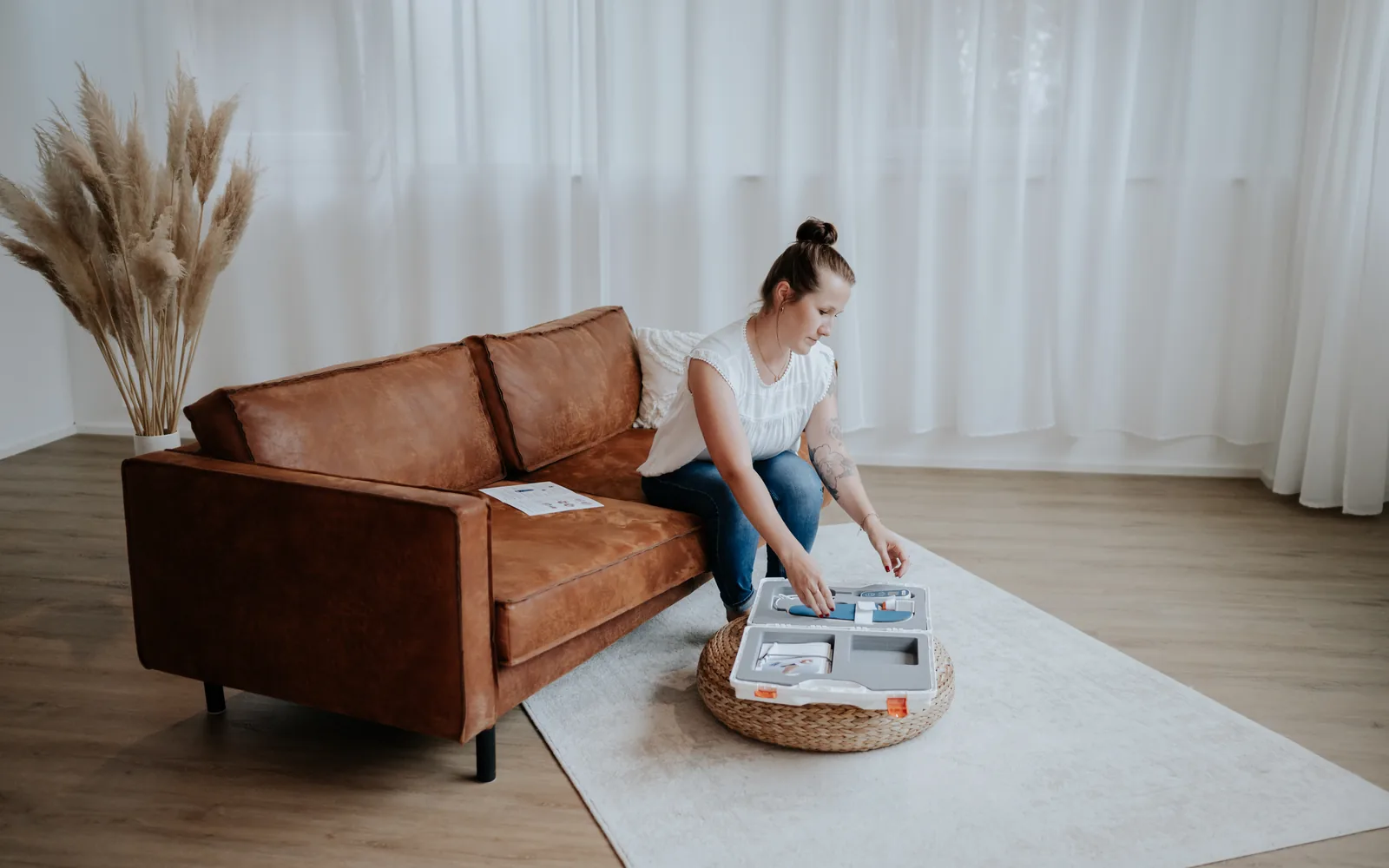
Passive motion at home after surgery
The Hall-U-Sana® toe CPM device moves the big toe joint with a motor and without any effort on your part: programme 1 for the phase directly after surgery with 20 degrees up and 10 degrees down, programme 2 for the later phase with 40 and 20 degrees, each for 25 minutes twice a day while you sit. There is nothing to set: you place your foot in the device and start the programme. Hall-U-Sana® is a Class IIa medical device (CE) for rehabilitation after surgery on the first ray. It is available to rent through distribution partners in Germany, Switzerland and France, see Sources of supply, and the studies are on the studies page. It is not cleared by the FDA and is not available in the United States. Whether and from when the device makes sense after your operation is decided by your surgeon.
Conclusion
Wide shoes from week 4 to 6, your usual ones after three months, heels as an exception from month 4 to 6: that is the framework, and it applies because the foot first becomes wider and then narrower. Buy wider, not bigger, and only buy for good once the swelling has gone. In sport the order is the same everywhere, cycling and water before running, running before ball sports, and the swelling the next morning decides the next stage, not the calendar. After a fusion, the return to sport takes longer. Which week applies to you is set out in the aftercare plan of your surgical team.
Frequently asked questions about shoes and sport after bunion surgery
What shoes can I wear six weeks after bunion surgery?
Soft, wide shoes with a firm sole and an adjustable fastening, in other words a trainer or hiking shoe with plenty of room over the ball of the foot. The Schulthess Klinik, Aarau and the Praxis Leonardo recommend exactly this combination, and the Gelenk-Klinik has it worn for a further four to six weeks. Buy wider rather than bigger, and in the afternoon, because the foot still swells in the evening for months.
When can you wear high heels again after bunion surgery?
The only study with a figure gives a median of 16 weeks after minimally invasive correction, with a range of 13.5 to 20.5 weeks. The clinics only say that tight shoes should wait for at least six months and that high heels should not be part of everyday life after that, because they markedly increase the pressure on the big toe and the first metatarsal. After a fusion, the angle of the toe decides.
How long after bunion surgery before you can do sport?
Movement without impact is allowed early: an exercise bike after two to ten weeks depending on the clinic, swimming once the wound is dry from week 5 to 7. Running comes after six weeks to four months, ball sports after three to six months, and contact sport in Kassel only after a year. In athletes, it took an average of 8.9 weeks after osteotomies to return to activity. Your surgical team gives the go-ahead after an X-ray and examination.
Can you still do sport after fusion of the big toe joint?
Yes, with a delay. Running at the earliest after three months, ball sports after six to nine months, and before that three to six months of flat shoes with a stiffening insole. In studies, 96% of young patients were satisfied, running, golf, hiking and tennis remained possible as before for most, and all skiers returned to their level, 40% with an adapted ski boot. A quarter needed more than a year to reach full performance.
When can you walk barefoot again after bunion surgery?
No clinic gives a fixed time. As long as the post-op shoe is being worn, it stays on at home too, because the forefoot must not roll through. Once you are cleared for normal shoes, there is nothing against short distances barefoot on a soft floor as soon as the swelling allows; in the long term, the Gelenk-Klinik recommends walking barefoot as often as possible because it strengthens the foot muscles. Ask your practice when it is right for your foot.
About the author: Dr Franz Freuler is a Specialist in Orthopaedic Surgery FMH. In 2005 he built the first prototype of a motorised continuous passive motion device for the big toe joint, which became the Hall-U-Sana®. He is co-founder and CTO of U-Sana Medical AG in Oberwil near Basel.
This guide provides general information and does not replace a medical examination. When you may wear which shoes and which sport you may do is decided by your surgical team.
Sources
- Rojas-Toro DE, Protasowicki N, Ruiz RR et al. Return to daily and sports activities after minimally invasive transverse osteotomy and Akin (META) for hallux valgus: setting realistic expectations. J Foot Ankle Surg 2026, published online ahead of print. PubMed 42235816
- Dayton M, Dayton P, Togher CJ, Thompson JM. What do patients report regarding their real-world function following triplane metatarsophalangeal joint arthrodesis for hallux valgus? J Foot Ankle Surg 2023;62:254-260. PubMed 35999115
- Lotan R, Shlomov B, Dotan A, Bermant A, Hershkovich O. Hallux valgus repair with chevron osteotomy significantly narrows forefoot width. J Clin Med 2023;12:2607. PubMed 37048690
- Thordarson D, Ebramzadeh E, Moorthy M, Lee J, Rudicel S. Correlation of hallux valgus surgical outcome with AOFAS forefoot score and radiological parameters. Foot Ankle Int 2005;26:122-127. PubMed 15737253
- Menz HB, Morris ME. Footwear characteristics and foot problems in older people. Gerontology 2005;51:346-351. PubMed 16110238
- Menz HB, Roddy E, Marshall M et al. Epidemiology of shoe wearing patterns over time in older women: associations with foot pain and hallux valgus. J Gerontol A Biol Sci Med Sci 2016;71:1682-1687. PubMed 26834078
- Nguyen US, Hillstrom HJ, Li W et al. Factors associated with hallux valgus in a population-based study of older women and men: the MOBILIZE Boston Study. Osteoarthritis Cartilage 2010;18:41-46. PubMed 19747997
- Mandato MG, Nester E. The effects of increasing heel height on forefoot peak pressure. J Am Podiatr Med Assoc 1999;89:75-80. PubMed 10063777
- Yung-Hui L, Wei-Hsien H. Effects of shoe inserts and heel height on foot pressure, impact force, and perceived comfort during walking. Appl Ergon 2005;36:355-362. PubMed 15854579
- Lalevee M, Saffarini M, van Rooij F, Nover L, Nogier A, Beaudet P. Recurrence rates with long-term follow-up after hallux valgus surgical treatment using shaft metatarsal osteotomies: a systematic review and meta-analysis. EFORT Open Rev 2024;9:933-940. PubMed 39360793
- Jeuken RM, Schotanus MG, Kort NP, Deenik A, Jong B, Hendrickx RP. Long-term follow-up of a randomized controlled trial comparing scarf to chevron osteotomy in hallux valgus correction. Foot Ankle Int 2016;37:687-695. PubMed 27009063
- Raikin SM, Miller AG, Daniel J. Recurrence of hallux valgus: a review. Foot Ankle Clin 2014;19:259-274. PubMed 24878414
- Coughlin MJ, Grebing BR, Jones CP. Arthrodesis of the first metatarsophalangeal joint for idiopathic hallux valgus: intermediate results. Foot Ankle Int 2005;26:783-792. PubMed 16221449
- Alentorn-Geli E, Gil S, Bascuas I et al. Correlation of dorsiflexion angle and plantar pressure following arthrodesis of the first metatarsophalangeal joint. Foot Ankle Int 2013;34:504-511. PubMed 23396178
- Garcia SC, Zona NE, Hunt KJ, Jamieson MD. Return to physical activity and footwear modifications after first metatarsophalangeal joint arthrodesis, including alpine sports: a retrospective case series. Foot Ankle Orthop 2026;11(2). PubMed 42046548
- Saxena A. Return to athletic activity after foot and ankle surgery: a preliminary report on select procedures. J Foot Ankle Surg 2000;39:114-119. PubMed 10789102
- Fournier M, Saxena A, Maffulli N. Hallux valgus surgery in the athlete: current evidence. J Foot Ankle Surg 2019;58:641-643. PubMed 30448185
- MacMahon A, Karbassi J, Burket JC et al. Return to sports and physical activities after the modified Lapidus procedure for hallux valgus in young patients. Foot Ankle Int 2016;37:378-385. PubMed 26578481
- Schroeder P, Nicholes M, Baynes T, Huh J, Dowd T. What proportion of active-duty servicemembers functionally improve at 1 year post hallux valgus correction? Clin Orthop Relat Res 2022;480:2174-2179. PubMed 35353079
- Da Cunha RJ, MacMahon A, Jones MT et al. Return to sports and physical activities after first metatarsophalangeal joint arthrodesis in young patients. Foot Ankle Int 2019;40:745-752. PubMed 30990076
- Baumann AN, Walley KC, Kermanshahi N et al. Return to sport after first metatarsophalangeal arthrodesis: a systematic review. Foot Ankle Int 2023;44:1319-1327. PubMed 37750390
- Mulier T, Steenwerckx A, Thienpont E et al. Results after cheilectomy in athletes with hallux rigidus. Foot Ankle Int 1999;20:232-237. PubMed 10229279
- Schuh R, Hofstaetter SG, Kristen KH, Trnka HJ. Effect of physiotherapy on the functional improvement after hallux valgus surgery: a prospective pedobarographic study. Z Orthop Unfall 2008;146:630-635. PubMed 18846491
- Wong DW, Cheung JC, Zhao JG, Ni M, Yang ZY. Forefoot function after hallux valgus surgery: a systematic review and meta-analysis on plantar load measurement. J Clin Med 2023;12:1384. PubMed 36835920
- Kaczmarczyk K, Barton GJ, Wiszomirska I, Wychowanski M. Women after bilateral surgical correction of hallux valgus do not show improvement in spatiotemporal gait parameters at 18 weeks postoperatively. J Clin Med 2021;10:608. PubMed 33562797
- Gumuskaya O, Peterson B, Donnelly H, Unver B, Lafferty D, Tehan P. Preoperative and postoperative physical and mechanical rehabilitation interventions in hallux valgus: a systematic review. J Foot Ankle Res 2025;18:e70083. PubMed 40936159
- Connor JC, Berk DM, Hotz MW. Effects of continuous passive motion following Austin bunionectomy. A prospective review. J Am Podiatr Med Assoc 1995;85:744-748. PubMed 8592286
- Frigg A, Zaugg S, Maquieira G, Pellegrino A. Stiffness and range of motion after minimally invasive chevron-Akin and open scarf-Akin procedures. Foot Ankle Int 2019;40:515-525. PubMed 30688526
- Green Halimi Y, Efrima B, Elkaïm M et al. Hallux valgus treatment by percutaneous scarf-like screwless osteotomy. Orthop Traumatol Surg Res 2024;110:103963. PubMed 39059549
- Ciechanowicz D, Kozłowski J, Kołodziej Ł, Kromuszczyńska J. Return to physical activities after scarf osteotomy for hallux valgus. Ortop Traumatol Rehabil 2020;22:95-106. PubMed 32468995
- Stinus H, Roch F, Wille S, Perthel R, Lehmann W (Universitätsmedizin Göttingen): Orthopaedic forefoot surgery, certified continuing medical education. Hessisches Ärzteblatt 02/2026 (PDF, in German). laekh.de
- Deutsches Ärzteblatt: Hallux valgus guideline updated (S2e guideline 187-051 of the DGOU), news of 5 February 2026 (in German). aerzteblatt.de
- Kantonsspital Olten, Dr. med. Sandra Meier, Dr. med. Katharina Cichon: Hallux valgus and hallux rigidus, patient information (PDF, in German). solothurnerspitaeler.ch
- Universitätsklinik Balgrist Zürich: Hallux valgus, distal metatarsal osteotomy, and arthrodesis of the big toe joint, patient information (PDF, in German). balgrist.ch
- Kantonsspital Aarau, Klinik für Orthopädie und Traumatologie: Patient information on hallux valgus treatment (PDF, in German). ksa.ch
- Schulthess Klinik Zürich, foot surgery (senior consultant Dr. med. Simone Zwicky): Hallux valgus, treatment and aftercare (in German). schulthess-klinik.ch
- Praxis LEONARDO, Hirslanden Klinik Birshof Münchenstein, Dr. med. Rahel Schmid, Dr. med. Sonja Gaber, Dr. med. Britta Broede, Dr. med. Claude Müller: Information sheets on hallux valgus and hallux rigidus 2025 (PDF, in German); Dr. med. Josef Strehle, Hirslanden Salem-Spital Bern: Hallux valgus (PDF, in German). leonardo-ortho.ch
- Gelenk-Klinik Gundelfingen, Dr. med. Thomas Schneider, Dr. med. Martin Rinio: Hallux valgus; hallux valgus surgery; arthrodesis for hallux rigidus; joint-preserving surgery for hallux rigidus (in German). gelenk-klinik.de
- Klinikum Kassel, Klinik für Unfallchirurgie, Prof. Dr. Clemens Dumont: Aftercare plan for hallux valgus surgery (PDF, 12/2022, in German). gesundheit-nordhessen.de
- Klinikum Bamberg, Prof. Dr. med. Peter Strohm, Dr. med. A. Saal: Aftercare plans for hallux valgus, arthrodesis of the big toe joint and Lapidus arthrodesis (PDF, 02/2023, in German). sozialstiftung-bamberg.de
- ORTHO PEDE Berlin, Dr. med. Stefan Böhr: Sport after hallux valgus surgery (2026) and running after hallux valgus surgery (checked 2026) (in German). ortho-pede.de
- OrthoPedes Duisburg, Dr.-medic Manuel Nastai: Minimally invasive hallux valgus surgery, and After foot surgery, what happens next? (in German). drnastai.de
- Fußchirurg Hannover, Dr. med. Ryszard van Rhee: Frequently asked questions answered briefly (in German). fusschirurg-hannover.de
- Lumedis Frankfurt, Dr. med. Nicolas Gumpert, Dr. med. Marc Jungermann: The optimal treatment of hallux valgus, patient book (PDF, in German). lumedis.de
- ATOS Klinik Heidelberg, Prof. Dr. med. habil. Hajo Thermann, Dr. med. Sigmund Polzer, Dr. med. Steffen Berlet: ATOS Thema Fuß, 2015 (PDF, in German); Prof. Dr. med. Norbert Harrasser, ECOM München: article 2025 (PDF, in German). atos-kliniken.com
- Schön Klinik, Prof. Dr. Markus Walther: Hallux valgus, and hallux valgus, treatment (in German). schoen-klinik.de
- Priv.-Doz. Dr. Reinhard Schuh, Vienna: Hallux valgus surgery, frequently asked questions, and aftercare after foot surgery (in German). orthopaede-drschuh.at
- Elisabethinen-Krankenhaus Klagenfurt, OA Dr. Patrick Brabant: Jogging despite foot deformity, granatapfel magazine 6/2023 (PDF, in German). barmherzige-brueder.at
- AMEOS Klinikum Bernburg, chief physician Dr. med. Tobias Schaaf: Hallux valgus, patient leaflet 06/2018 (PDF, in German). ameos.de
- Orthozentrum Cham, Dr. med. Rolf F. Oetiker: The time after foot surgery, information sheet (PDF, in German). orthozentrum.ch
- Helios Gesundheit, Philip Krekosch, senior physician at Helios ENDO-Klinik Hamburg: Hallux valgus, as of 15 September 2026 (in German). helios-gesundheit.de
- Märkische Kliniken Lüdenscheid: Aftercare for hallux valgus, 05/2020 (PDF, in German); Universitätsklinikum Münster, Prof. Dr. Sabine Ochman: Aftercare plan for hallux valgus forefoot surgery, 10/2023 (PDF, in German). maerkische-kliniken.de
Sources as of 2 November 2026. The online sources were accessed on this date, and the studies are linked via PubMed.